

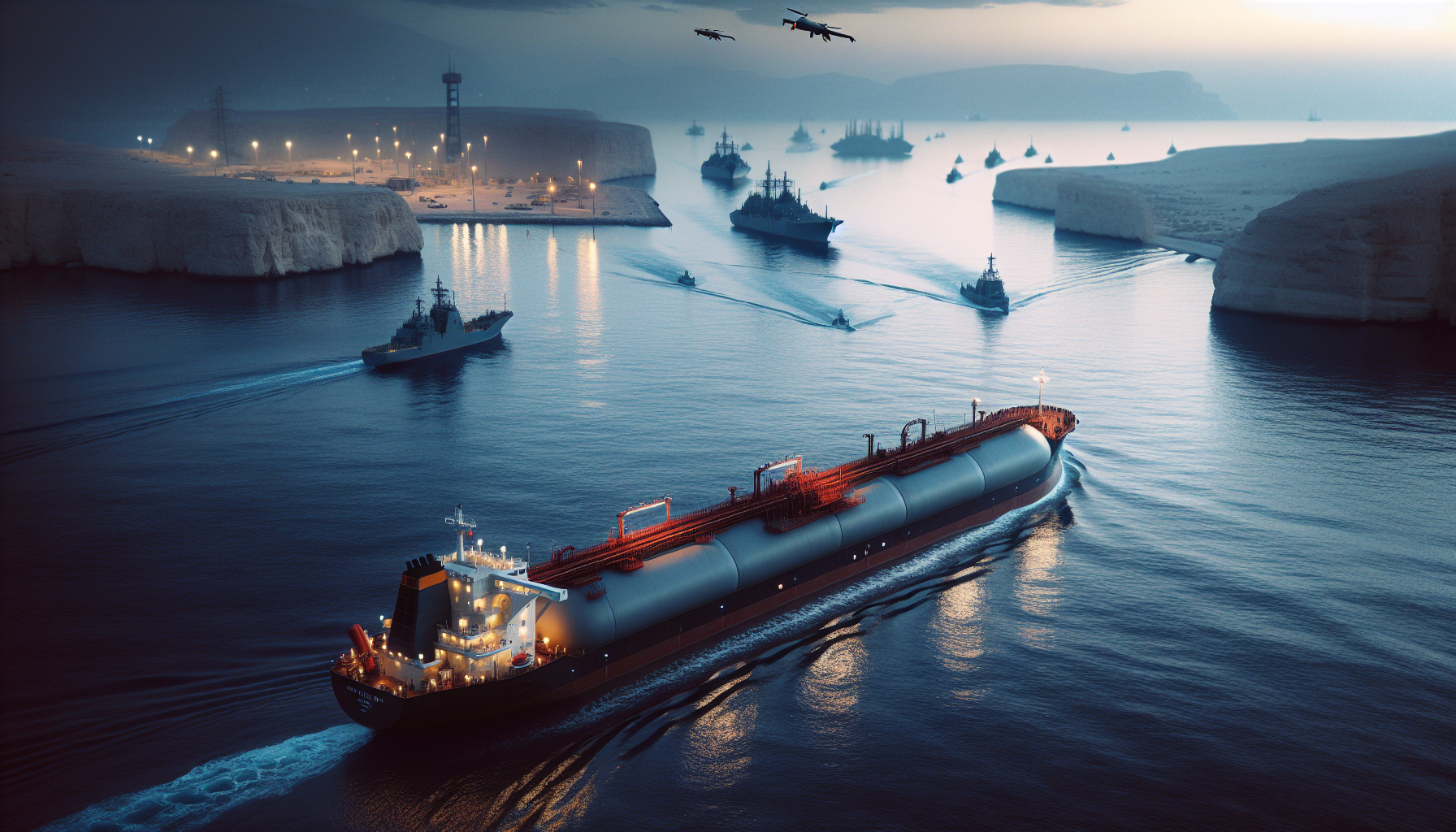
On February 28, just a day before Israel and the United States launched attacks on Iran, the Indian-flagged LPG tanker Pine Gas loaded cargo at the Ruwais port in the United Arab Emirates, anticipating a week-long journey home. However, the vessel’s safe transit through the Strait of Hormuz took nearly three weeks due to Iran’s selective allowance of ships through the strategically crucial waterway.
Sohan Lal, Chief Officer of Pine Gas, recounted that the ship’s 27 Indian crew members witnessed missiles and drones flying overhead daily while waiting. A video recorded during this period showed at least five projectiles streaking across the night sky above the tanker.
Initially, Indian authorities instructed the crew to prepare to sail around March 11. Yet, with the conflict intensifying, clearance to move was delayed until March 23. Notably, the tanker was directed by Iran’s Islamic Revolutionary Guard Corps (IRGC) to navigate an uncommon narrow channel north of Larak Island, rather than the usual shipping lanes through the Strait.
Lal explained that the Indian government and the ship’s owner, Mumbai-based Seven Islands Shipping, agreed to proceed via the alternate route only after securing unanimous consent from the entire crew. “They required a definitive yes or no from all onboard, and everyone agreed,” he said.
The IRGC recommended this northern Larak route because the regular Hormuz passage was reportedly mined. During the transit, the Indian Navy provided guidance and subsequently escorted the tanker for nearly 20 hours from the Gulf of Oman to the Arabian Sea. Lal confirmed that no fees were paid for the passage, and the IRGC never boarded the vessel.
The Indian Navy has affirmed its role in escorting Indian-flagged ships after they pass through the Strait of Hormuz. The Indian Foreign Ministry highlighted that Indian naval presence in the Gulf of Oman and Arabian Sea has been ongoing for years to safeguard maritime routes for Indian and other vessels.
India depends heavily on imported liquefied petroleum gas (LPG), which is used by hundreds of millions of households for cooking. The Pine Gas, carrying 45,000 metric tons of LPG, was initially scheduled to unload at the western port of Mangalore. However, Indian authorities redirected the cargo to be discharged equally at the eastern ports of Visakhapatnam and Haldia.
Iran has stated it permits passage through the Strait of Hormuz to “friendly nations” including China, Russia, India, Iraq, and Pakistan. While six Indian ships have successfully exited the Strait, 18 Indian-flagged vessels carrying approximately 485 Indian seafarers remain in the Persian Gulf amid ongoing tensions.
