

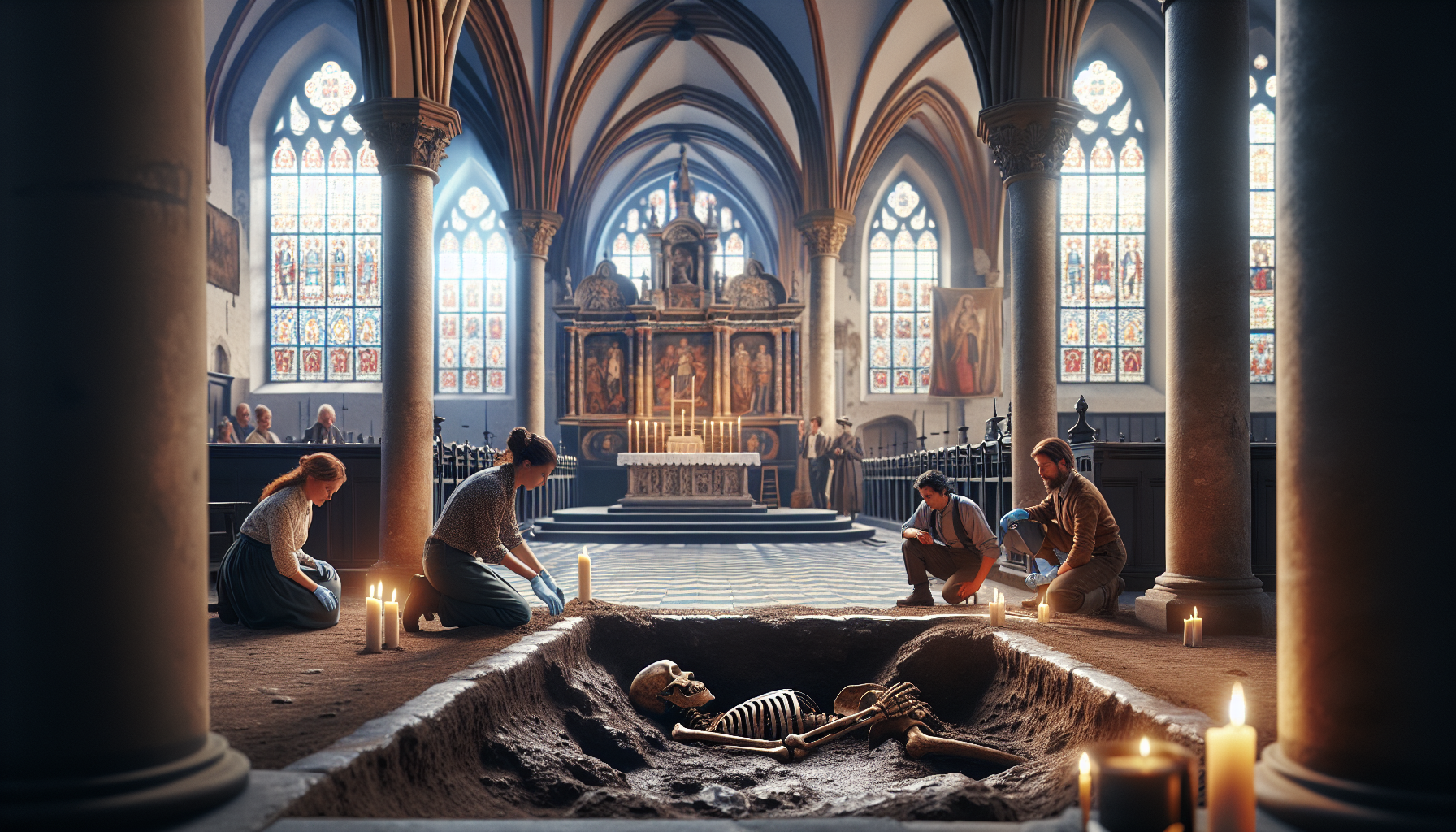
Workers repairing a church floor in Maastricht, Netherlands, have uncovered a skeleton that could be that of Charles de Batz-Castelmore, famously known as d’Artagnan. This 17th-century Gascon nobleman inspired Alexandre Dumas’ iconic character in The Three Musketeers, a figure immortalized in literature, film, and even animation.
In a significant development, the remains were found beneath the altar of the Church of St. Peter and St. Paul in the Wolder neighborhood, where the floor had subsided. Deacon Jos Valke noted that the burial site was in consecrated ground, accompanied by a French coin from the era and a musket ball lodged at chest height, matching historical accounts of d’Artagnan’s fatal injury during the 1673 Siege of Maastricht.
Retired archaeologist Wim Dijkman, who has dedicated 28 years to locating the musketeer’s remains, was called to the site. While acknowledging the importance of the find, Dijkman emphasized scientific caution, stating that thorough investigations are ongoing both locally and internationally to confirm the identity of the skeleton.
The bones have been transferred to an archaeological institute in Deventer, where DNA samples taken on March 13 are being analyzed in Munich. These will be compared with genetic material from descendants of d’Artagnan’s father to verify a match.
Charles de Batz-Castelmore served as a musketeer and spy under King Louis XIV until his death in battle. His posthumous fame skyrocketed after Dumas published The Three Musketeers in 1844, drawing inspiration from a semi-fictional memoir written in 1700 by Gatien de Courtilz de Sandras. Over the years, the character has been portrayed by numerous actors including Douglas Fairbanks, Michael York, Chris O’Donnell, Logan Lerman, and François Civil. Notably, in the early 1980s, d’Artagnan was reimagined as a sword-wielding beagle in the animated series Dogtanian and the Three Muskehounds.
