



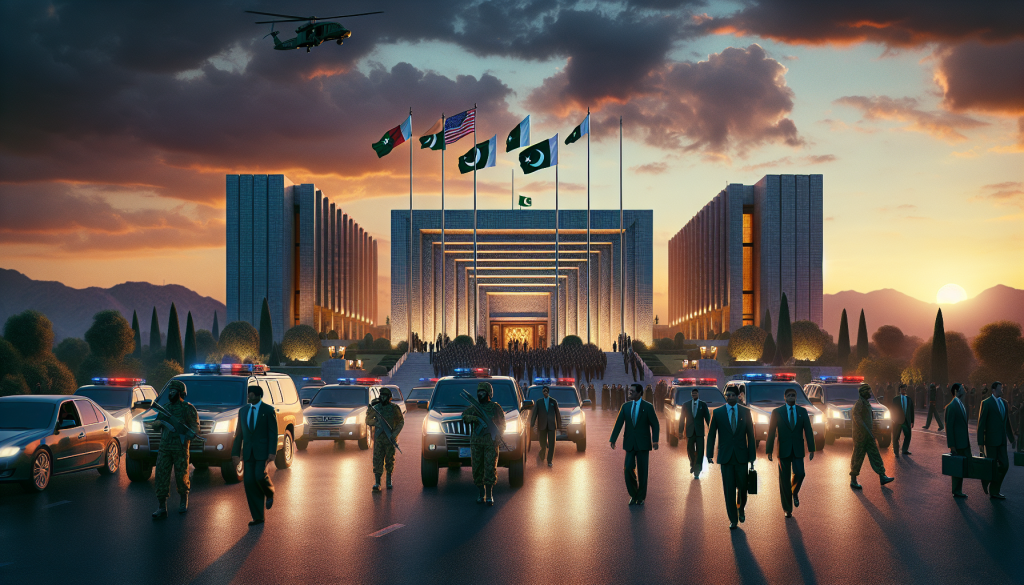
Islamabad has emerged as the focal point of international diplomacy as critical negotiations between the United States and Iran take place, following weeks of intense conflict. Senior officials from both nations convened in Pakistan’s capital to pursue efforts aimed at ending the ongoing war.
Over the past 72 hours, multiple high-ranking delegations have engaged in vigorous diplomatic discussions, underscoring the gravity of the situation. The city has witnessed extraordinary security measures reflecting the talks’ importance. These negotiations follow a 40-day period marked by joint US-Israeli strikes on Iran, culminating in the assassination of Supreme Leader Ayatollah Ali Khamenei.
Prime Minister Shehbaz Sharif has been instrumental in initiating the peace process, initially calling for a ceasefire and subsequently inviting both parties to Islamabad for direct dialogue. Since then, the capital has seen rapid developments, drawing significant international media attention with over 100 foreign and 200 local journalists covering the so-called “Islamabad Talks.” Approximately 200 officials from the US, Iran, and other countries are present, engaged in efforts to resolve the Middle East crisis.
Notably, this event marks a rare milestone in Pakistan’s diplomatic history: it is the first occasion a sitting US vice president has visited Pakistan under a civilian government. Previous visits by US presidents such as George Bush in 2006 and Bill Clinton in 2000 occurred during military rule under General Pervez Musharraf. Earlier visits by Richard Nixon, Lyndon Johnson, and Dwight Eisenhower also took place during military regimes. Former Vice President Joe Biden visited Pakistan in 2011 while President Asif Ali Zardari was in office.
Analysts in Islamabad assess that the US-Iran conflict has substantially shifted global power dynamics, especially in the Middle East. The war disrupted crucial energy corridors, including the Strait of Hormuz, triggering a sharp rise in oil prices and affecting economies worldwide.
The fragile ceasefire, established after weeks of violence affecting thousands and destabilizing markets, holds for now but remains vulnerable due to differing interpretations and ongoing tensions, including Israeli strikes in Lebanon. Pakistan, grappling with economic challenges, has been significantly impacted by rising energy costs but also finds itself at the center of global diplomatic efforts.
Conversations with diplomats, analysts, and journalists over the past three days reveal cautious optimism. While the success of the talks is uncertain, there is consensus on the high stakes involved. A positive outcome could reopen the Strait of Hormuz, a vital maritime route responsible for nearly 20 percent of global oil shipments before the conflict. Conversely, failure could exacerbate regional instability.
Experts warn that escalation could draw Pakistan into a broader conflict, particularly with Iran, creating a “nightmarish scenario” involving multiple simultaneous security challenges. Consequently, Pakistan is eager for a successful resolution, leveraging its unique position of maintaining working relations with the US, Iran, Saudi Arabia, and other Gulf nations.
Attention also focuses on Pakistan’s military leadership, especially Field Marshal Syed Asim Munir, who is perceived as playing a key role in facilitating the peace process. Islamabad is concurrently seeking to strengthen economic ties with Washington, including potential cooperation in critical mineral resources.
As negotiations proceed, Islamabad remains central to a diplomatic effort that could reshape regional dynamics and determine whether the current ceasefire leads to lasting peace.
The talks are hosted in Islamabad, where Pakistan acts as a mediator between Washington and Tehran. Pakistan’s credibility is enhanced by its 900-kilometer border with Iran and the absence of US military bases on its soil. Prime Minister Shehbaz Sharif has welcomed both delegations, with Deputy Prime Minister and Foreign Minister Ishaq Dar overseeing the formal proceedings.
The negotiations commenced on the morning of April 11 at approximately 11:45 a.m. local time and may extend late into the night or continue over several days or weeks, with some delegation members expected to remain or return for further discussions.
The US delegation is led by Vice President JD Vance, accompanied by President Donald Trump’s special envoy Steve Witkoff and adviser Jared Kushner. Iran’s representatives include Parliament Speaker Mohammad Bagher Ghalibaf and Foreign Minister Abbas Araghchi. It remains unclear if other countries are formally involved beyond Pakistan’s role as host and mediator.
Prime Minister Sharif has conducted separate meetings with both delegations, and senior Pakistani officials such as President Asif Ali Zardari and Field Marshal Asim Munir have also engaged with visiting representatives. While it is not officially confirmed whether the US and Iranian sides have held direct negotiations at the Convention Centre, unconfirmed some level of direct interaction may have begun. Such engagement between Vice President Vance and Speaker Ghalibaf would be a significant development, given the lack of high-level direct contact in recent years.
Analysts caution that deep mistrust between the US and Iran lowers the likelihood of an immediate final agreement. Additionally, ongoing Israeli attacks on Lebanon could jeopardize the talks, considering their impact on the broader conflict. Nonetheless, both sides appear fatigued by weeks of fighting and might be open to incremental progress, particularly regarding nuclear tension reduction and restoring safe passage through the Strait of Hormuz.
Pakistan has considerable economic and strategic interests in the outcome. Its economy depends heavily on remittances from over 10 million overseas Pakistanis, about 80 percent of whom reside in the Middle East, mainly Saudi Arabia, the UAE, Qatar, Bahrain, and Kuwait. Any escalation in the Gulf could disrupt employment opportunities and reduce foreign exchange inflows.
Officials emphasize that sustained peace would bolster Pakistan’s trade and economic relations, including with Iran, and facilitate the revival of key energy projects like the Iran-Pakistan gas pipeline to meet growing energy demands. Experts also warn that a wider conflict could trigger a refugee influx, straining Pakistan’s already limited resources.

Leave an opinion