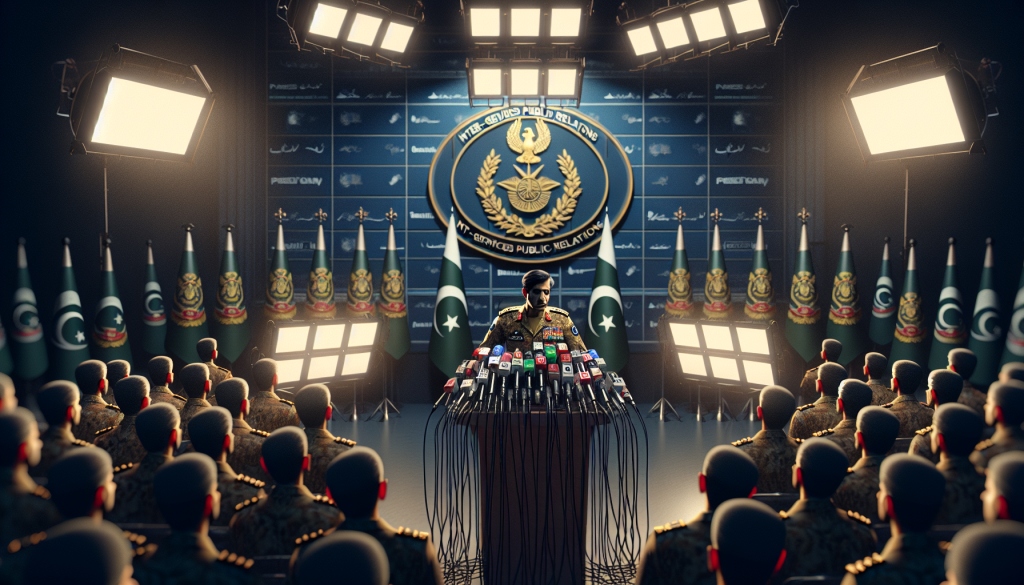
In a detailed address, Lieutenant General Ahmed Sharif Chaudhry, Director General of the Inter-Services Public Relations (ISPR), brought to light serious concerns regarding the Afghan Taliban regime’s alleged involvement in sheltering militants within government infrastructure. Speaking candidly about the ongoing security challenges, he emphasized that Pakistan continues to wage a relentless war against terrorism, a conflict that has been thrust upon the country by hostile elements and their foreign backers.
Highlighting the gravity of the situation, the ISPR chief stated that the Afghan Taliban have been using official buildings as safe havens for terrorists. This revelation underscores the complex security dynamics in the region, where militant groups exploit state resources to further their agendas. Lt Gen Chaudhry further asserted that the Taliban maintain active connections with various terrorist organizations, including individuals linked to the late al-Qaeda leader Osama bin Laden. He specifically mentioned Hamza bin Laden, Osama’s son, who is reportedly in contact with the Taliban and has been invited to Afghanistan, raising alarms about the resurgence of extremist networks.
It is worth noting that Osama bin Laden was killed in a high-profile US Navy SEAL operation in Abbottabad on May 2, 2011. His death marked a significant milestone in the global fight against terrorism, as he was the mastermind behind the devastating 9/11 attacks in New York, which claimed over 3,000 lives. Despite this, the ISPR chief’s comments suggest that the ideological and operational threats linked to his legacy continue to pose challenges in the region.
Meanwhile, Lt Gen Chaudhry strongly refuted claims made by the Afghan Taliban regarding civilian casualties resulting from recent Pakistani military strikes. He clarified that these operations were precisely targeted based on verified intelligence, focusing on an ammunition depot and a drone storage facility in Kabul. The strikes, he explained, were aimed at neutralizing threats posed by missiles and drones stored at these sites. The resulting explosions caused large fires visible across Kabul, providing tangible evidence of the operation’s success.
The military spokesperson also disclosed that drones used against Pakistan were supplied by India to the Afghan regime, highlighting the cross-border dimensions of the conflict. He reiterated that Pakistan’s military actions are grounded in credible intelligence and supported by recorded footage, underscoring the transparency and precision of these counterterrorism measures.
In a related development, Lt Gen Chaudhry drew attention to recent terrorist attacks within Pakistan, linking perpetrators to Afghanistan. He cited an explosion in a mosque located in Tarlai, which tragically resulted in the deaths of worshippers and children, attributing the attack to an assailant who crossed over from Afghanistan. Additionally, he mentioned that five militants involved in an assault on Wana Cadet College were Afghan nationals. These incidents, he stressed, reaffirm Pakistan’s focus on targeting militants rather than civilians.
To date, Pakistan has conducted 81 strikes against terrorist infrastructure inside Afghanistan, a testament to its ongoing commitment to combating militancy. The ISPR chief accused the Taliban regime of spreading misinformation and retracting false claims, thereby attempting to manipulate public perception. He also shed light on the troubling trend of suicide attackers being under the influence of drugs, a tactic observed in several past attacks.
Addressing the issue of drone incursions, Lt Gen Chaudhry confirmed that all drones originating from Afghanistan have been successfully shot down by Pakistani forces. He questioned the origin of these drones, pointing out that Afghanistan lacks the capability to manufacture such technology, thereby implying external support for these hostile activities.
Despite the tensions, the ISPR chief reiterated Pakistan’s willingness to engage in dialogue with the Afghan Taliban. However, he expressed skepticism regarding the Taliban’s commitment to any agreements, emphasizing the need for concrete guarantees. He highlighted Pakistan’s active counterterrorism operations within its own borders, noting that over 200 operations are conducted daily to curb militant activities and cross-border smuggling, which have reportedly declined as a result.
In conclusion, Lt Gen Chaudhry issued a stern message to the Afghan Taliban regime, urging them to make a definitive choice between supporting terrorism or pursuing peace. He questioned their priorities, particularly in relation to the Tehrik-i-Taliban Pakistan (TTP), and called on them to decide whether their allegiance lies with militant groups or with fostering stability and cooperation with Pakistan.