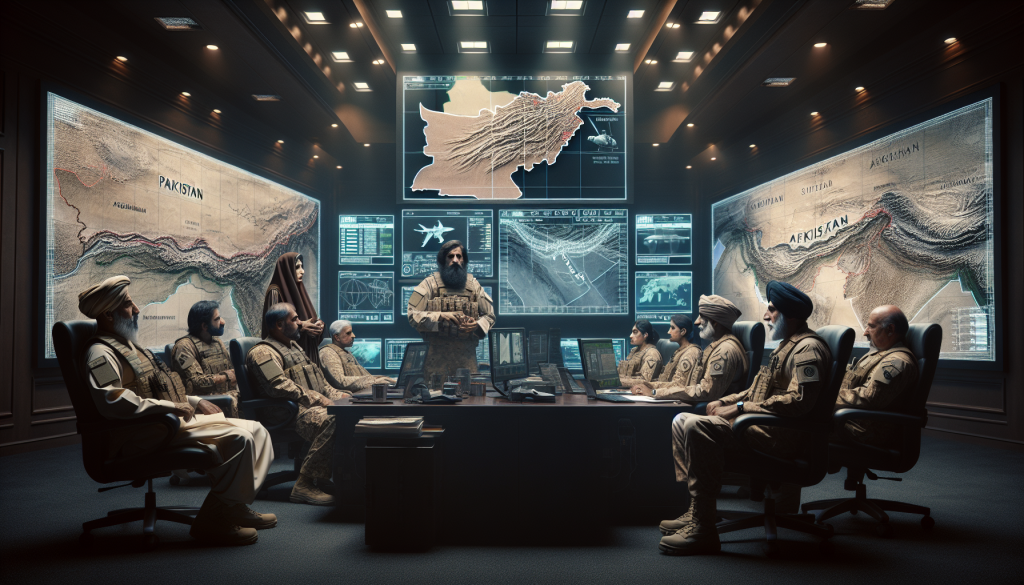
In a detailed statement addressing the ongoing security concerns along Pakistan’s western border, Lieutenant General Ahmed Sharif Chaudhry, Director General of Inter-Services Public Relations (ISPR), accused the Afghan Taliban regime of providing sanctuary to militants within government infrastructure. Speaking candidly about the complex security dynamics, he emphasized that Pakistan continues to wage a relentless battle against terrorism, a conflict that has been thrust upon the nation by hostile elements and their external backers.
During a recent televised discussion, the ISPR chief revealed that the Taliban leadership in Afghanistan has been actively concealing terrorists inside official buildings, a move that complicates efforts to stabilize the region. He underscored the troubling ties between the Afghan Taliban and various extremist groups, including connections with Hamza bin Laden, the son of the late al-Qaeda leader Osama bin Laden. This relationship, he noted, is not merely speculative but has been acknowledged by international bodies such as the United Nations, which classify the Taliban as a terrorist organization controlling Afghanistan.
It is worth noting that Osama bin Laden was killed in a high-profile U.S. Navy SEAL operation in Abbottabad on May 2, 2011. The al-Qaeda chief was held responsible for orchestrating the devastating September 11 attacks in New York City, which claimed over 3,000 lives. The ISPR chief’s remarks highlighted concerns that the Taliban have invited Hamza bin Laden to Afghanistan, potentially signaling a resurgence of extremist activities in the region.
Lieutenant General Chaudhry further elaborated on Pakistan’s position, stressing that the country is engaged in a war against terrorism imposed upon it by militants and their external sponsors. He pointed fingers at India, alleging that several militant groups operating against Pakistan receive support and funding from Indian sources. This accusation adds another layer to the already tense relations between the two neighboring countries.
In a related development, the ISPR chief dismissed claims made by the Afghan regime regarding civilian casualties resulting from recent Pakistani military strikes. He clarified that the operations targeted specific militant infrastructure, including an ammunition depot and a drone storage facility located in Kabul. him, these strikes were based on precise and verified intelligence, aimed at neutralizing threats rather than causing harm to innocent civilians.
He described the aftermath of the attack on the ammunition site, noting that the explosions led to prolonged fires visible across Kabul, providing tangible evidence of the operation’s success. The ISPR spokesperson also shared that Pakistan possesses video footage and other records corroborating the accuracy of their strikes. This transparency, he suggested, counters misinformation propagated by the Afghan Taliban.
Adding to the complexity of the security situation, Lieutenant General Chaudhry revealed that drones used by the Afghan regime in recent hostile activities against Pakistan were supplied by India. He questioned the origin of these unmanned aerial vehicles, pointing out that Afghanistan lacks the capability to manufacture such technology. This raises concerns about the involvement of third-party actors in destabilizing the region further.
Despite the ongoing tensions, the ISPR chief reiterated Pakistan’s willingness to engage in dialogue with the Afghan Taliban. However, he expressed skepticism about the Taliban’s commitment to peace, highlighting the absence of reliable guarantees from their side. Pakistan’s military continues to conduct extensive counterterrorism operations domestically, with over 200 missions carried out daily to dismantle militant networks and curb cross-border smuggling activities.
Lieutenant General Chaudhry also touched upon recent terrorist incidents within Pakistan, including a deadly blast at a mosque in Tarlai that claimed the lives of worshippers and children. He stated that the attacker originated from Afghanistan, and similarly, the militants involved in the attack on Wana Cadet College were Afghan nationals. These incidents underscore the persistent threat posed by militants operating across the border.
He concluded by urging the Afghan Taliban regime to make a definitive choice between supporting terrorism or pursuing peace. The ISPR chief questioned whether the Taliban prioritize the Tehrik-i-Taliban Pakistan (TTP) over maintaining peaceful relations with Pakistan. His remarks serve as a stark reminder of the fragile security environment and the urgent need for regional cooperation to combat terrorism effectively.