

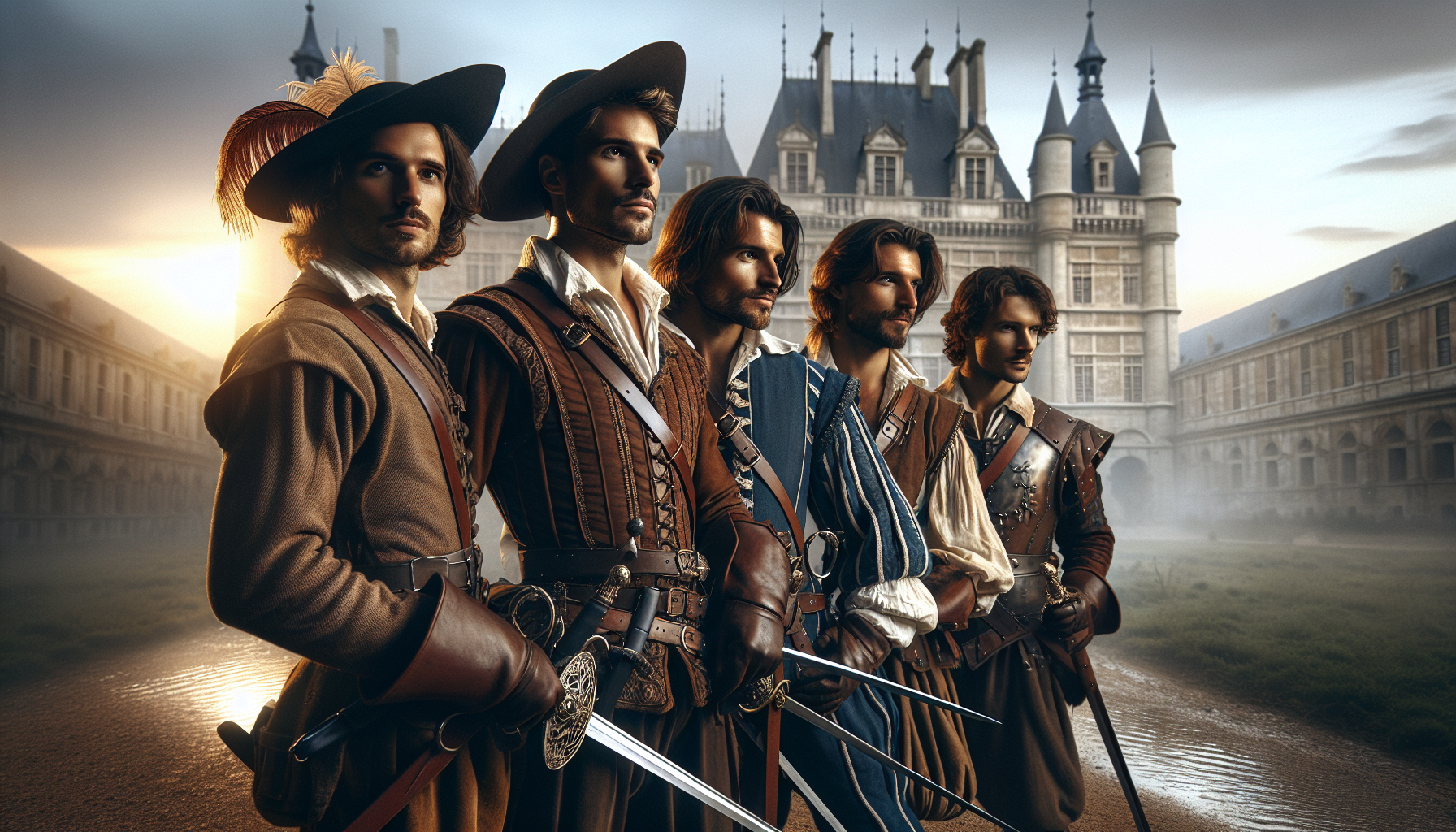
The Three Musketeers, one of the most celebrated adventure tales ever penned, has enthralled readers and audiences for over 180 years with its stories of swordplay, loyalty, and political intrigue. Yet, many question whether the musketeers were genuine historical figures or purely fictional creations. The truth lies somewhere in between: largely fictional, but built upon an intriguing historical foundation. Alexandre Dumas did not invent everything from thin air; instead, he drew from actual individuals, a real elite military unit, and authentic 17th-century events, weaving them into an exhilarating narrative.
Dumas’ novel, originally published in serialized form in 1844 under the French title Les Trois Mousquetaires, follows the journey of young d’Artagnan, a courageous Gascon who arrives in Paris with hopes of joining the King’s Musketeers. He soon bonds with three inseparable comrades—Athos, Porthos, and Aramis—together embarking on daring missions involving stolen diamonds, the cunning spy Milady de Winter, political machinations orchestrated by Cardinal Richelieu, and the siege of La Rochelle. The story is rich with duels, romance, and the iconic motto: “All for one, and one for all!” While Dumas collaborated with Auguste Maquet on research and plotting, it was Dumas’ literary flair that transformed historical notes into a thrilling adventure. The novel was followed by two sequels, Twenty Years After and The Vicomte of Bragelonne, completing the D’Artagnan Romances.
In reality, the Musketeers of the Guard were a genuine elite cavalry unit formed in the early 17th century under King Louis XIII. Serving as both royal bodyguards and an elite fighting force, they were armed with muskets but primarily engaged in sword combat on horseback. Membership was typically reserved for men of noble or well-connected families, granting them significant prestige. This unit existed until the French Revolution and was renowned for its bravery and distinctive uniforms. Dumas set his story during the reign of Louis XIII, around 1625 to 1628, a period marked by political tensions involving the king, Queen Anne of Austria, and Cardinal Richelieu. Events such as the siege of La Rochelle and court rivalries in the novel have clear historical roots.
The characters, though dramatized, are based on real musketeers from the 17th century. Dumas found their names in old memoirs, especially a semi-fictional account by Gatien de Courtilz de Sandras, and reimagined their personalities and stories. Charles de Batz de Castelmore, Comte d’Artagnan (circa 1611–1673), was a real captain-lieutenant who served mainly under Louis XIV and died heroically at the Siege of Maastricht. The genuine d’Artagnan joined the Musketeers later than depicted and had a distinguished career involving secret missions but was not the youthful adventurer portrayed in the book. Athos was inspired by Armand de Sillègue d’Athos d’Autevielle (circa 1615–1643), a nobleman who died young in a duel; Porthos was based on Isaac de Portau, a boastful musketeer from a prominent family; and Aramis drew from Henri d’Aramitz, who came from a clerical family and later became an abbot, aligning with the character’s religious inclinations. These men served in the Musketeer company during the 1640s, not the 1620s as in the novel, and while they likely knew each other, they were not the inseparable band depicted by Dumas. The legendary exploits, camaraderie, and specific adventures are largely romanticized fiction.
Dumas expertly blended fact and fiction, anchoring his story in real historical events and figures but taking creative liberties to enhance drama. While the Musketeers, Louis XIII, Queen Anne, Cardinal Richelieu, and events like the siege of La Rochelle are historically accurate, the novel’s timeline, character relationships, and many personal exploits were altered or invented. Dumas famously remarked that history was the “nail” on which he hung his novels, resulting in a tale that feels authentic yet delivers nonstop excitement.
The enduring appeal of The Three Musketeers stems from its themes of loyalty, honor, courage, and friendship, which continue to resonate with audiences worldwide. The novel has inspired over fifty screen adaptations, including the energetic and humorous 1973/1974 films directed by Richard Lester, starring Michael York, Oliver Reed, and Raquel Welch. The 1993 Disney version featuring Charlie Sheen, Kiefer Sutherland, and Chris O’Donnell offered a family-friendly take, while earlier classics like the 1921 silent film with Douglas Fairbanks and the 1948 MGM production starring Gene Kelly remain beloved. More recent adaptations, such as those from 2011 and 2023 in France, continue to introduce new generations to the swashbuckling action and intrigue of 17th-century France.
In conclusion, the Three Musketeers were not real in the exact manner portrayed by Dumas—their adventures are fictional—but they were inspired by actual historical figures and a genuine elite military unit. Alexandre Dumas masterfully combined fact with imagination to create one of literature’s most enduring adventure stories. Whether you enjoy the original novel, the numerous film adaptations, or simply love tales of daring swordsmen, The Three Musketeers exemplifies how legends can grow from kernels of truth. For those new to the story, starting with Dumas’ original work is recommended, available in many accessible editions. Alternatively, classic film adaptations offer a thrilling visual journey through the intrigue and valor of 17th-century France.
