


The Islamabad High Court (IHC) on Monday postponed the hearing of appeals filed by Pakistan Tehreek-e-Insaf (PTI) founder Imran Khan and his wife, Bushra Bibi, challenging their convictions in the £190 million Al-Qadir Trust case. The bench accepted a request from their legal counsel, who claimed he had been denied adequate access to his clients.
A division bench, led by Chief Justice Sarfraz Dogar along with Justice Muhammad Asif, was hearing the appeals when Barrister Salman Safdar sought an adjournment, stating a miscellaneous application had been submitted in this regard.
The application highlighted that despite clear orders from the IHC, meetings with Imran Khan and Bushra Bibi have not been arranged to obtain instructions necessary for pursuing the appeals. It further noted that Imran’s three sisters remain in custody, preventing any instructions from them as well.
Safdar informed the court that while he had met Imran Khan following the bench’s directives, the situation was different for Bushra Bibi. He revealed, “My last meeting with Bushra Bibi was in December 2025,” emphasizing that no meetings had been arranged with her in the past ten months. He requested that at least one meeting with Bushra Bibi be facilitated.
In a significant development, the application also pointed out that a petition challenging the declaration that Bushra Bibi’s sentence suspension was ineffective is currently pending before the Federal Constitutional Court. Safdar urged that the appeals should only be scheduled for hearing after that court delivers its verdict, arguing that proceeding now would undermine the ongoing case there.
Safdar also mentioned that Senior Advocate Sardar Latif Khosa was unable to attend court due to road closures and had submitted an application on his behalf. He acknowledged the court’s efforts to implement a digital working system but criticized the continued presence of obstacles and containers on roads despite explicit court orders.
Advocate Khalid Yousuf Chaudhry added that the relevant IHC office had initially refused to accept the application, stating that miscellaneous applications are not accepted on hearing days, instructing lawyers to present them during court proceedings instead.
Safdar questioned the timing of the hearing, noting the high temperature outside and expressing surprise that the case was scheduled at such a time. He suggested the registrar’s office should have avoided fixing the case then, as there was no apparent urgency.
Referring to an earlier bench order, he remarked, “We sometimes receive relief from the court and sometimes we do not. When aggrieved, we file appeals. I am personally affected by a previous order of this court.” The chief justice inquired if he intended to begin arguments that day, and Safdar responded that the prior order had made him question his removal from the case. When asked if he suspected any bias from the court, Safdar denied any such belief.
The court accepted the request for adjournment and postponed the hearing, with the next date to be announced after the written order is issued.
The £190 million Al-Qadir Trust case involves allegations that Imran Khan and Bushra Bibi received land and other benefits from a real estate firm in exchange for legalizing funds recovered by the United Kingdom and returned to Pakistan. The case traces back to December 2018, when the UK’s National Crime Agency (NCA) froze bank accounts linked to property tycoon Malik Riaz. In 2019, the NCA settled with Riaz’s family for £190 million, including a London property valued at approximately £50 million and funds from frozen accounts.
Earlier in 2019, Pakistan’s Supreme Court accepted Riaz’s offer of Rs460 billion in settlement, following findings that his firm Bahria Town had illegally acquired large tracts of land in Karachi. The recovered money was transferred to the Supreme Court’s account rather than the government’s. Then-special assistant on accountability Mirza Shahzad Akbar justified this by stating the apex court was part of the government and cited confidentiality agreements with the UK for withholding details.
The issue resurfaced in June 2022 after an alleged audio leak of a conversation between Riaz and his daughter, which Riaz dismissed as fabricated. Shortly after, then-interior minister Rana Sanaullah accused Imran and Bushra of accepting Rs5 billion and hundreds of kanals of land to protect the real estate firm. He alleged that Bahria Town had donated land to the Al-Qadir Trust, which had only two trustees: Imran and Bushra. Akbar was said to have “settled” the matter by adjusting Rs50 billion against the firm’s liability. The federal cabinet subsequently formed a committee to investigate.
The National Accountability Bureau (NAB) summoned Malik Riaz and other beneficiaries in December 2022 and had earlier issued notices to 21 members of Imran’s cabinet. The NAB’s reference claimed Imran played a “pivotal role” in the illicit transfer of funds meant for the state. Several individuals, including Riaz, his son Ahmed Ali Riaz, Akbar, Zulfi Bukhari, Farhat Shahzadi, and Ziaul Mustafa Nasim, were named, with some declared proclaimed offenders after failing to appear, leading to property freezes.
Imran Khan was first arrested on May 9, 2023, while appearing before the Islamabad High Court in an unrelated case. His detention sparked nationwide protests and riots, and he was released after the Supreme Court deemed the arrest unlawful. He was arrested again by NAB in November 2023 in connection with this case and has been in custody since.
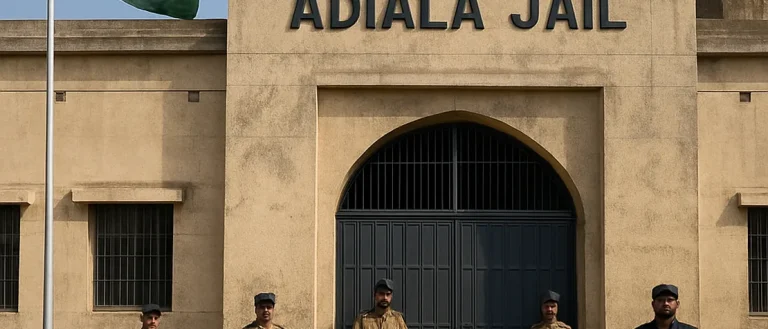
In February 2024, an accountability court indicted Imran and Bushra. After multiple delays, Judge Nasir Javed Rana convicted them on January 17, 2025, at a makeshift court in Adiala Jail. Imran received a 14-year sentence and a fine of Rs1 million, while Bushra was sentenced to seven years with a Rs500,000 fine. Imran has consistently called the case “bogus” and politically motivated, accusing his opponents of weaponizing state institutions.








Leave an opinion