

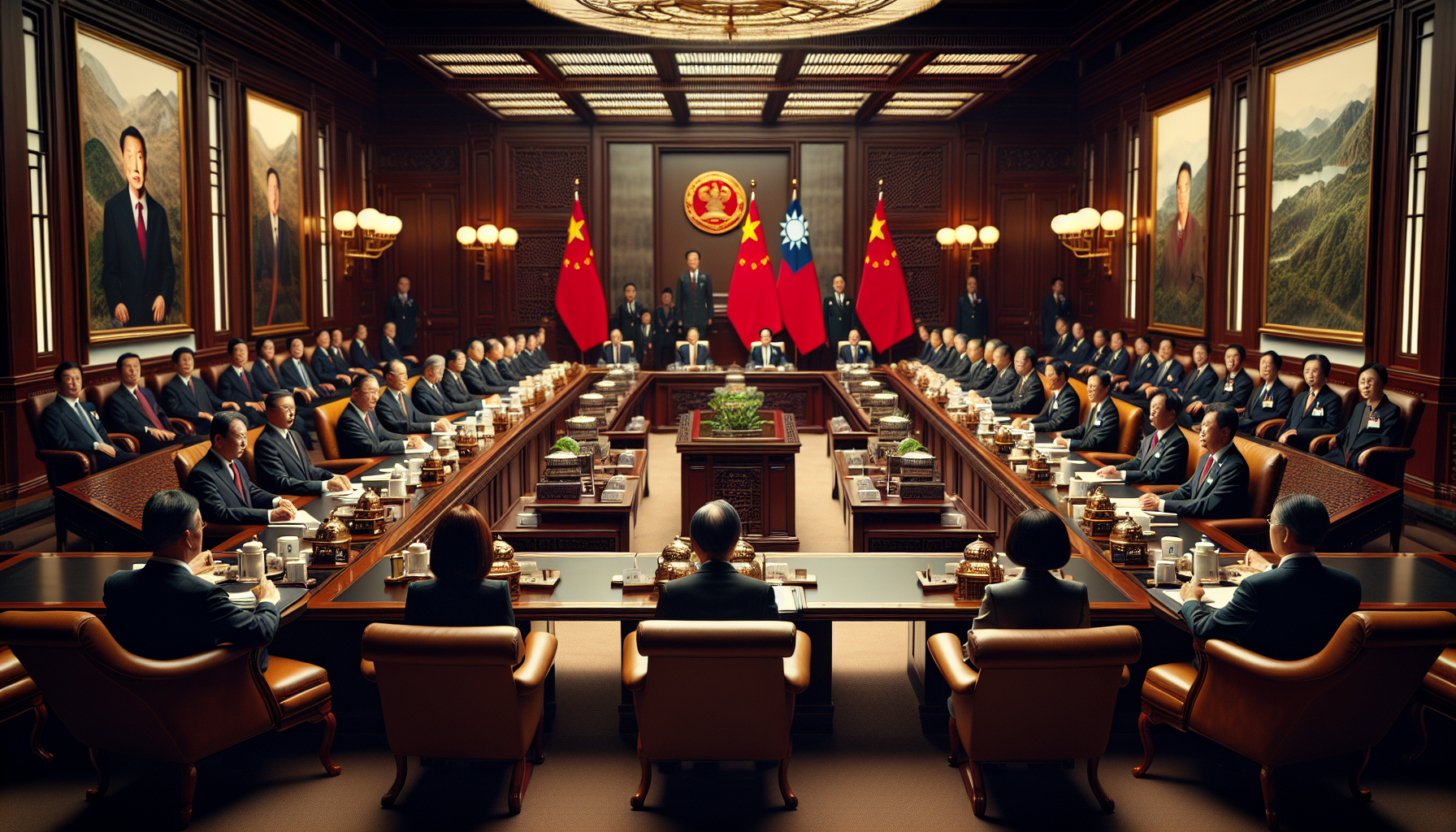
China’s President Xi Jinping held talks with Cheng Li-wun, leader of Taiwan’s opposition Kuomintang (KMT), in Beijing on Friday, expressing strong confidence that the people of Taiwan and China will ultimately unite. Cheng’s visit marks the first by a KMT chairperson to China in ten years, stirring debate in Taiwan where critics accuse her of favoring Beijing.
Since 2016, China has cut off high-level communications with Taiwan following the election of Democratic Progressive Party’s Tsai Ing-wen, who rejected Beijing’s sovereignty claims over the self-governed island. During the meeting, Xi emphasized that the trend of closer ties and eventual unity between compatriots on both sides of the Taiwan Strait is irreversible, calling it an inevitable historical process.
Xi also expressed willingness to enhance dialogue with Taiwanese groups, including the KMT, based on their shared opposition to Taiwan independence. The KMT advocates for stronger ties with China, which claims Taiwan as its territory and has not ruled out military action to enforce reunification.
Cheng urged that the Taiwan Strait cease to be a hotspot for conflict, advocating for transcending political divisions and pursuing systemic solutions to prevent war. She envisioned the strait becoming a global example of peaceful conflict resolution.
Despite Beijing’s repeated military pressure, including near-daily fighter jet and warship deployments and large-scale drills near Taiwan, Taiwanese lawmakers remain divided over a government proposal to allocate NT$1.25 trillion (US$39 billion) for defense spending. This plan has stalled in parliament, where the KMT holds significant influence.
Cheng’s visit comes a month before US President Donald Trump’s planned summit with Xi in Beijing. The United States has been urging Taiwanese opposition lawmakers to support defense acquisitions, including American arms, to deter potential Chinese aggression. However, Cheng criticized the government’s proposal, stating “Taiwan isn’t an ATM,” and instead backed a KMT plan to allocate NT$380 billion (US$12 billion) for US weapons, with flexibility for further purchases.
While KMT members frequently engage with Chinese officials, the last party leader to visit China was Hung Hsiu-chu in 2016. Cross-strait relations have notably deteriorated since Tsai’s successor, Lai Ching-te, took office; Beijing views Lai as a separatist. On Friday, Lai condemned China’s military threats around the Taiwan Strait, saying they severely undermine regional peace and stability.
Cheng arrived in Shanghai on Tuesday evening, expressing optimism that war between the two sides is not inevitable despite international concerns. During her trip, she also visited Nanjing, paying respects at the mausoleum of Sun Yat-sen, a revolutionary figure respected in both Beijing and Taipei.
