

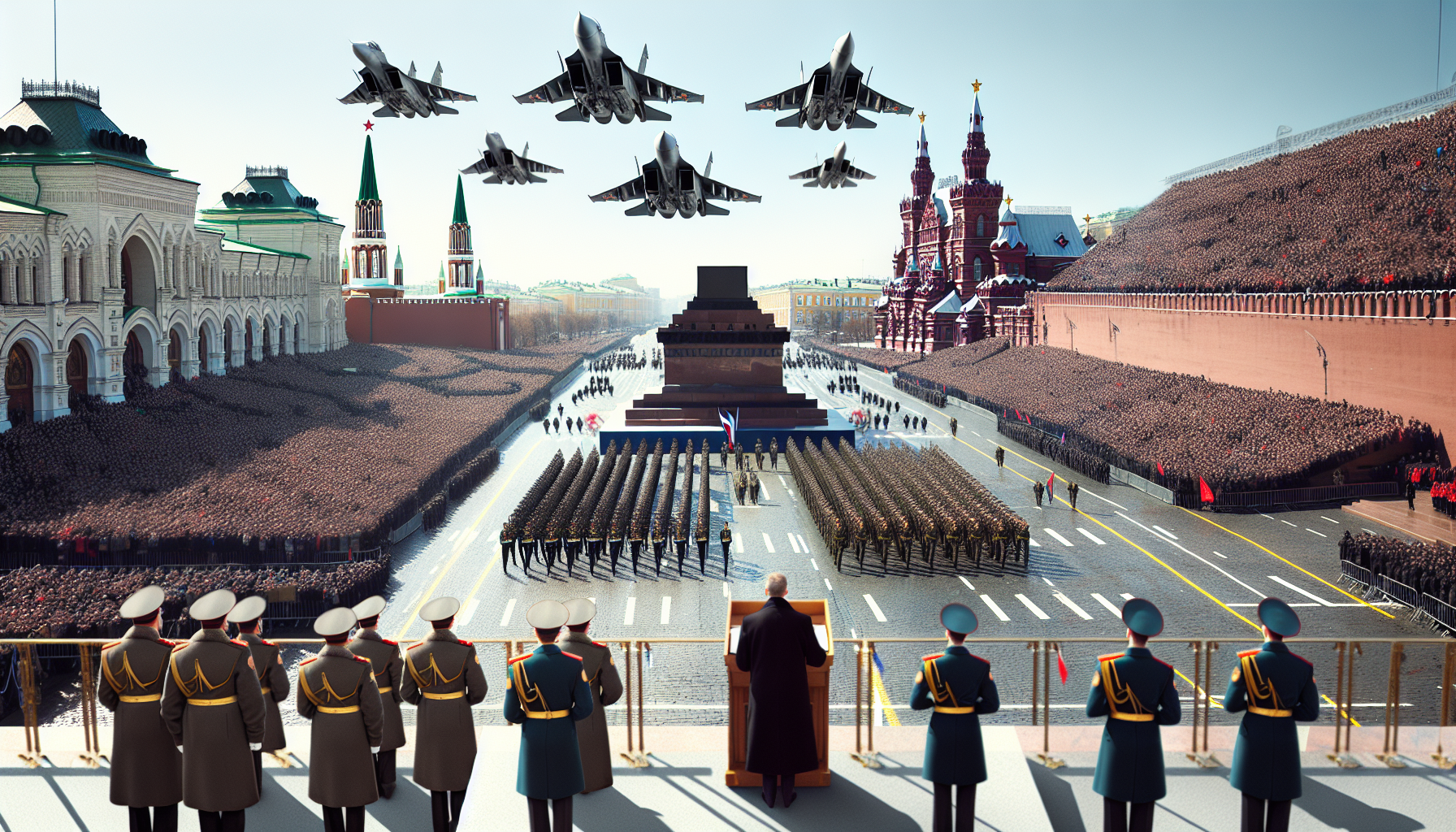
Russian President Vladimir Putin participated in a significantly scaled-down Victory Day parade on Saturday in Moscow’s Red Square. This event, commemorating the Soviet Union’s triumph over Nazi Germany in World War Two, remains Russia’s most important patriotic holiday, honoring the approximately 27 million Soviet citizens who perished during the war, including millions from Ukraine.
Unlike previous years, this parade omitted the traditional display of tanks and heavy military vehicles. Instead, advanced military systems such as the Yars intercontinental ballistic missile, Peresvet laser weapon, S-500 air defense system, Su-57 fighter jets, drones, and the Arkhangelsk nuclear submarine were showcased on large screens around Red Square and broadcast on state television.
Soldiers and sailors, some of whom have served in Ukraine, marched across the square as Putin observed from a podium near Lenin’s Mausoleum alongside war veterans. Notably, troops from North Korea, who reportedly participated in combat operations alongside Russian forces in the Kursk region, also took part in the procession.
Fighter jets performed flyovers above the Kremlin during the ceremony. In his eight-minute speech, Putin connected the World War Two victory with Russia’s ongoing military campaign in Ukraine, which the Kremlin refers to as a “special military operation.” He stated, “The great feat of the victorious generation inspires us today. Our soldiers are fighting for the security of Russia and the future of our state against forces supported by the entire NATO bloc.” He reaffirmed Russia’s commitment to continue the military operation despite external pressures.
Meanwhile, the parade took place shortly after US President Donald Trump announced a three-day ceasefire agreement between Russia and Ukraine from Saturday to Monday, reportedly accepted by both sides. The arrangement also included the exchange of 1,000 prisoners of war. Trump expressed his wish to see the conflict end, describing it as “the worst thing since World War Two in terms of life,” and hoped for a “big extension” of the ceasefire. No immediate violations of the ceasefire were reported.
Security measures in Moscow were significantly heightened, with armed soldiers patrolling in vehicles and major routes into central Moscow blocked. The city, home to around 22 million people, witnessed an increased military presence. Russia had earlier warned that any attempts to disrupt the parade could provoke retaliatory missile strikes on Kyiv, advising foreign diplomats to leave the Ukrainian capital if necessary.
In a symbolic move, Ukrainian President Volodymyr Zelenskiy issued a tongue-in-cheek decree permitting Russia’s parade to proceed, assuring that Ukrainian forces would not target Red Square during the event.
The ongoing war, now entering its fifth year, has resulted in hundreds of thousands of deaths, widespread destruction in Ukraine, and a profound rupture in Russia’s relations with the West not seen since the Cold War. The conflict has also exerted increasing pressure on Russia’s economy, with sanctions, military expenditures, and Western market isolation contributing to long-term challenges.
Despite the patriotic significance of Victory Day, this year’s subdued celebrations reflected rising unease within Russia regarding the war’s direction and its broader repercussions. Kremlin spokesman Dmitry Peskov dismissed Western media reports of internal instability or coup rumors as “fabrications,” with Russian officials consistently denying any leadership divisions.
Security Council Secretary Sergei Shoigu, previously regarded as a prominent military leader, attended the parade alongside senior officials, highlighting continued cohesion within the Kremlin’s highest ranks.
