

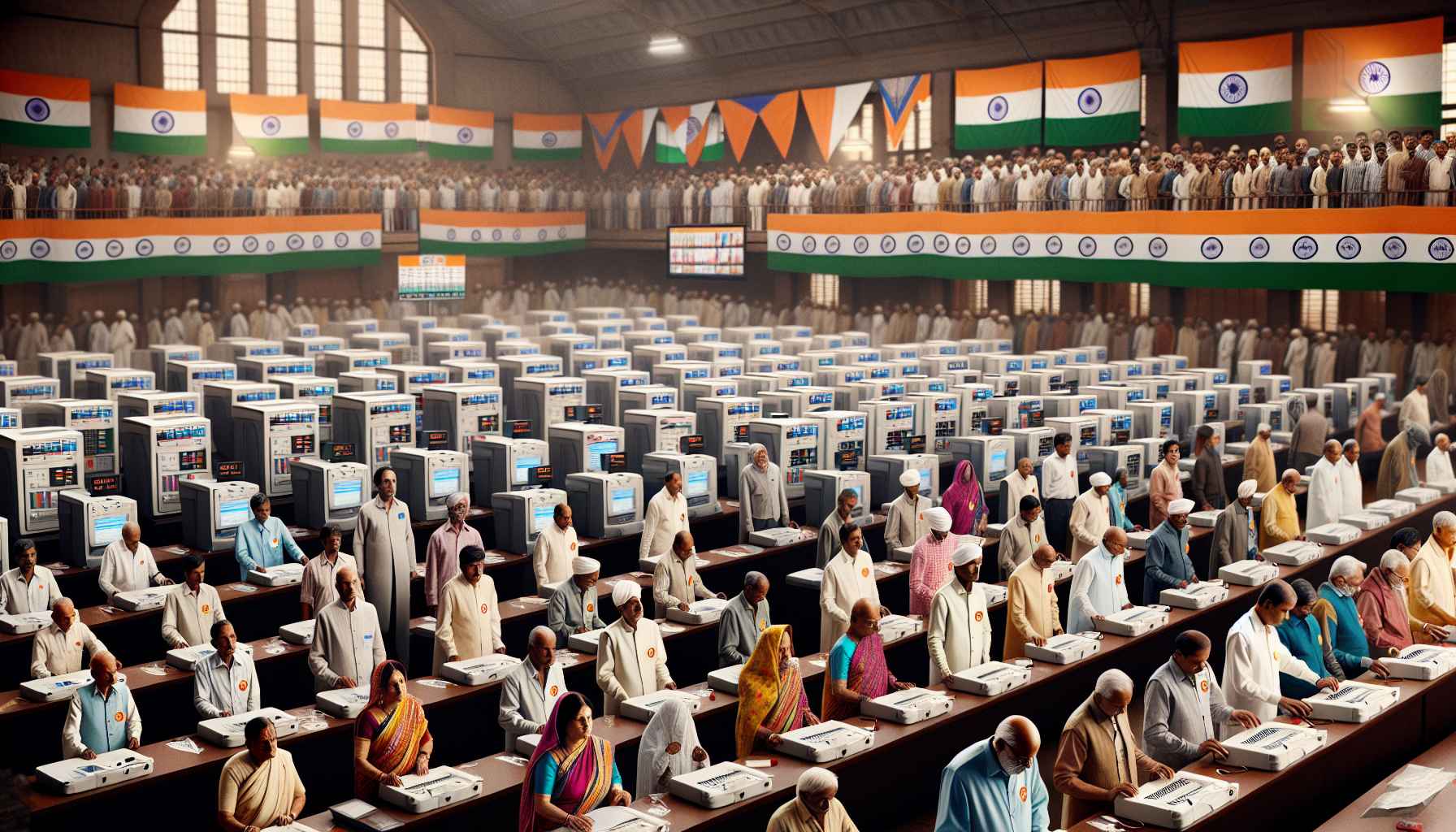
Vote counting is underway across five Indian states and union territories in a crucial election that could reshape the nation’s political landscape. Early results from Monday morning reveal a notable shift in traditional power centers as Prime Minister Narendra Modi’s Bharatiya Janata Party (BJP) aims to break opposition strongholds.
From the politically volatile plains of West Bengal to Assam’s tea gardens and Tamil Nadu’s coastal regions, anticipation runs high as initial Electronic Voting Machine (EVM) data is released. In a significant development, the BJP appears poised for a historic breakthrough in West Bengal, leading in over 160 of the 294 seats. This surge threatens to end Mamata Banerjee’s 15-year rule, with her party, the Trinamool Congress (TMC), trailing despite a vigorous campaign focused on regional identity.
Meanwhile, in Assam, the BJP is on track for a third consecutive victory, holding a strong lead that indicates voter preference for continuity under the National Democratic Alliance (NDA). The party’s dominance in the northeast reflects a consolidation of support in the region.
In the south, Tamil Nadu is witnessing a political upheaval as actor-turned-politician Vijay’s Tamilaga Vettri Kazhagam (TVK) emerges as an unexpected frontrunner. Early counts show TVK leading in over 100 seats, potentially disrupting the long-standing dominance of the DMK and AIADMK parties.
Kerala’s election results suggest the persistence of anti-incumbency sentiment, with the Congress-led United Democratic Front (UDF) gaining ground over the incumbent Left Democratic Front (LDF), diminishing Chief Minister Pinarayi Vijayan’s hopes for a third term. Meanwhile, in Puducherry, the NDA holds a narrow but consistent lead as the contest to form the next government continues.
As counting proceeds, the evolving trends across these regions highlight a dynamic and unpredictable electoral outcome that could significantly alter India’s political map.
