

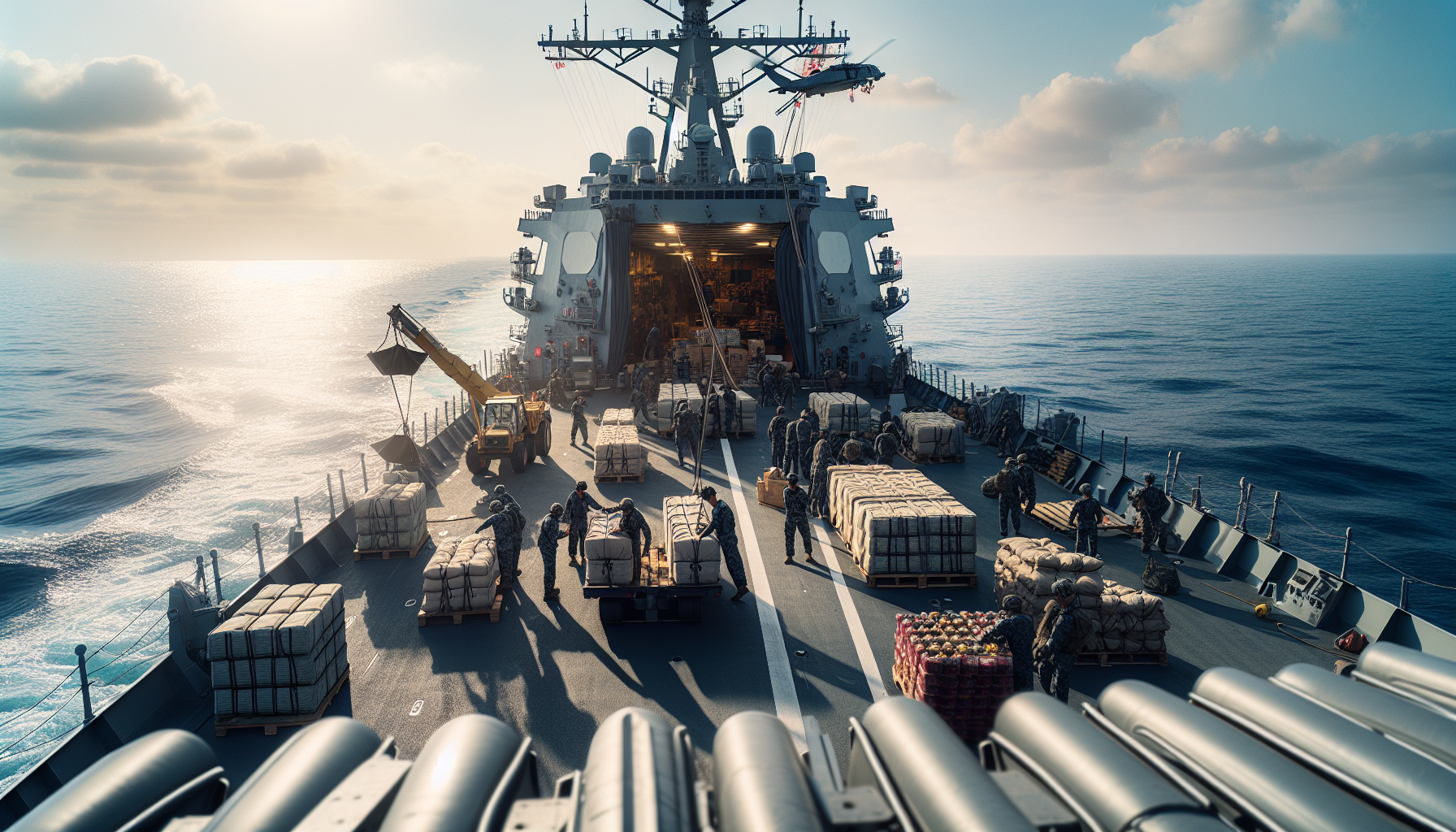
The United States military continues to support its naval forces deployed in the Middle East by resupplying vessels amid ongoing operations in the region. The US Central Command (Centcom), responsible for overseeing military activities related to the Iran conflict, confirmed that Navy ships are receiving fuel, food, ammunition, and other vital supplies to maintain their missions.
Centcom shared images showing the guided-missile destroyer USS Delbert D Black being loaded with supplies. This ship is operating in conjunction with the USS Abraham Lincoln Carrier Strike Group, which remains active in the area.
In a significant development affecting global energy markets, the United Arab Emirates (UAE) is set to leave the Organization of the Petroleum Exporting Countries (OPEC). As OPEC’s third-largest producer after Saudi Arabia and Iraq, the UAE’s departure could undermine the cartel’s control over oil supply management. Freed from OPEC’s production quotas, the UAE may substantially increase its oil output.
While increased supply might eventually ease global oil prices, immediate relief at the pump seems unlikely. Oil markets continue to face pressure due to geopolitical disruptions, particularly the partial closure of the Strait of Hormuz, a crucial route for global oil shipments. This closure has effectively removed an estimated 10 to 12 million barrels per day from the market, tightening supply regardless of OPEC’s internal dynamics.
Analysts highlight that the UAE has invested heavily in expanding its production capacity. Although OPEC quotas limited its output to around 3.2 million barrels per day, the country is believed to have the potential to produce nearly 5 million barrels daily. However, this additional supply would represent only about 1 to 2 percent of global demand, limiting its short-term impact on prices as long as supply routes remain constrained.
OPEC, established in 1960, once exerted significant influence over global oil markets, notably during the 1973 oil embargo, which caused sharp price increases and economic disruptions in the West. Over time, its power has diminished due to factors such as the rise of the US as a major oil producer, the global shift toward renewable energy, and improved energy efficiency. To maintain relevance, OPEC expanded into the OPEC+ alliance, including producers like Russia.
Today, OPEC+ accounts for roughly 40 percent of global crude production, and its decisions still affect price trends. However, the UAE’s exit raises concerns about the group’s internal unity and its ability to enforce coordinated production limits. Looking forward, analysts suggest that if supply routes stabilize and producers compete more aggressively, prices could face downward pressure. The UAE’s departure might also prompt further defections or trigger a price war among Gulf producers once regional tensions ease.
Before the recent conflict, oil markets were already trending toward oversupply, with production growth outpacing demand. The current surge in prices is largely attributed to geopolitical instability rather than fundamental shortages. Should conditions normalize and increased supply materialize, a more fragmented and less disciplined OPEC could shift the balance toward lower oil prices, potentially offering some relief to consumers at the pump.
