

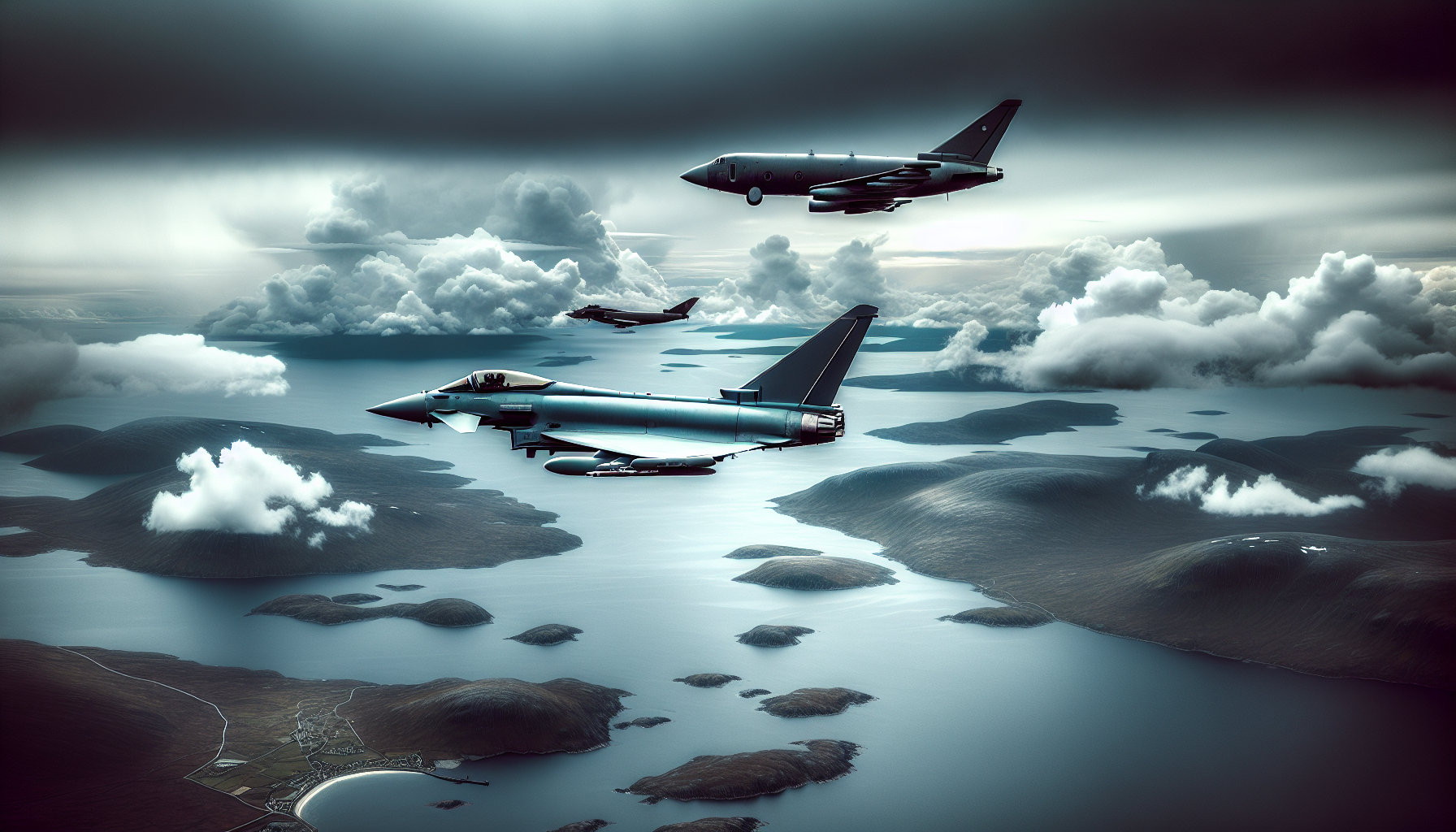
A tense aerial encounter unfolded off the northern coast of the United Kingdom when the Royal Air Force (RAF) deployed fighter jets in response to a suspected Russian long-range bomber approaching sensitive airspace near Scotland.
Two Eurofighter Typhoon jets were dispatched from RAF Lossiemouth, accompanied by a Voyager refueling aircraft from RAF Brize Norton, after radar detected an unidentified aircraft moving toward the Shetland Islands. This swift reaction reflects growing NATO concerns over increasingly assertive Russian military maneuvers near allied borders.
Although the aircraft, believed to be a Russian bomber, remained within international airspace and did not enter UK sovereign territory, defense officials characterized the situation as a “close watch” rather than a routine patrol. The RAF jets closely shadowed the aircraft until it changed course, after which they returned to base.
In a significant development, this incident is seen as part of a broader pattern of increased Russian military activity near Europe. Western defense sources note that such encounters have become more frequent amid heightened tensions between NATO and Moscow, especially following the escalation of the Russia-Ukraine conflict. Russian long-range aviation missions near European airspace often aim to test NATO’s response times and demonstrate military reach without crossing sovereign borders.
Meanwhile, this aerial episode follows a recent provocative naval move. A Russian warship was observed escorting sanctioned cargo vessels, including the Kremlin-linked ship Universal, through the English Channel. Although monitored by the Royal Navy, the vessels were permitted to pass, raising questions about enforcement boundaries and strategic signaling.
Security analysts interpret these coordinated air and naval operations as a deliberate show of force, carefully calibrated to avoid direct confrontation. This “calibrated pressure” strategy appears designed to probe NATO defenses and assert influence without triggering escalation.
For now, the latest RAF interception ended without incident, but it underscores how quickly routine surveillance can escalate into a tense standoff in an increasingly contested European security landscape.
