

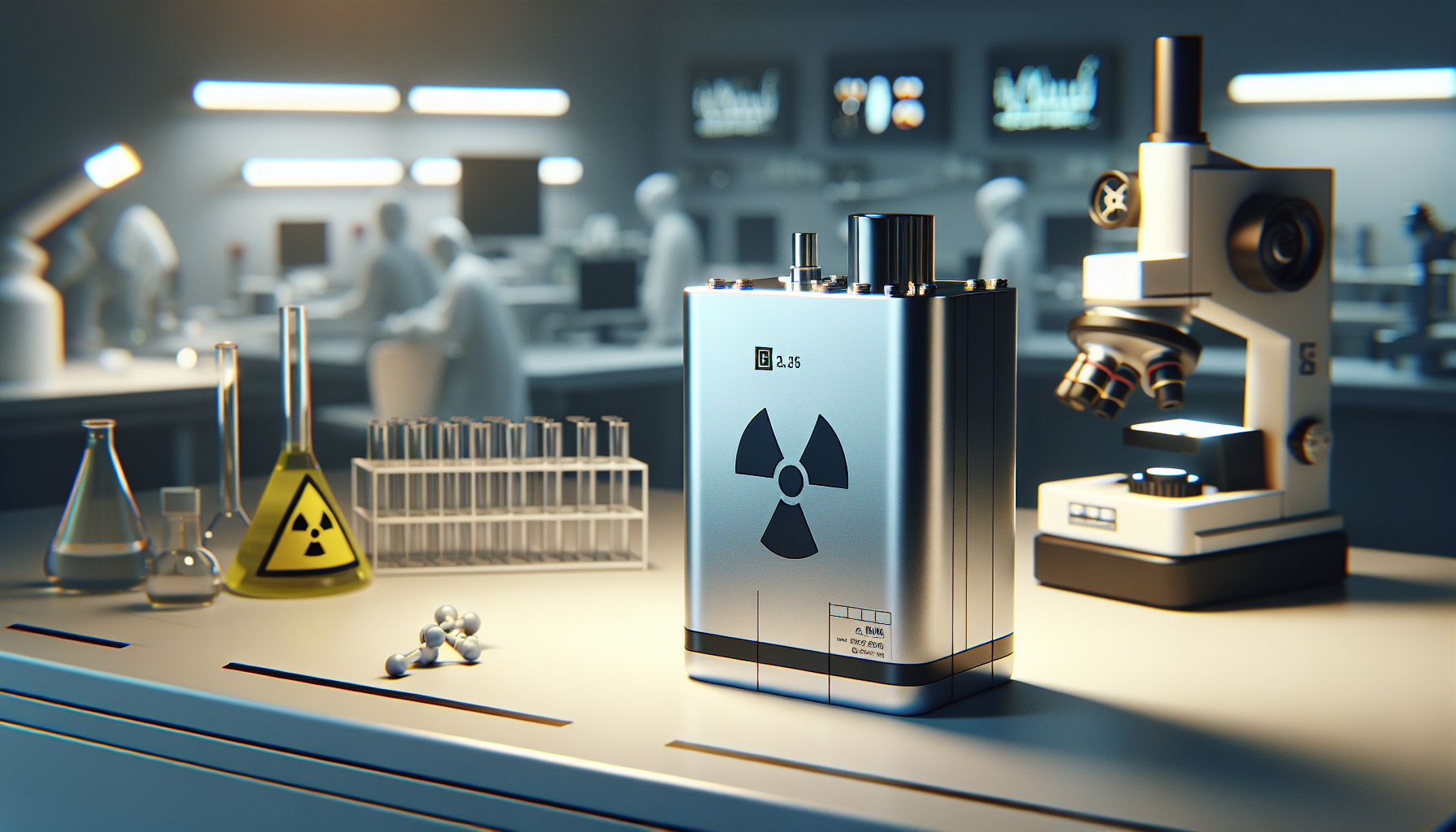
A U.S.-based nuclear materials company has introduced a solid-state battery that reportedly provides continuous power for more than 100 years without requiring maintenance. This innovative device is designed specifically for ultra-low power electronics used in remote or difficult-to-service environments.
The NBV series, developed by NRD LLC, employs a betavoltaic design powered by the radioactive decay of Nickel-63 to generate electricity. Encased in a solid-state structure, the battery is intended for applications where battery replacement or recharging is impractical.
Betavoltaic technology converts energy from beta decay into electrical current. Unlike traditional batteries, these devices rely on a steady radioactive decay process, enabling them to function for extended periods at very low power levels. NRD emphasizes that the NBV series supports electronics requiring a reliable, long-term energy supply, particularly in settings with limited access or where maintenance costs are prohibitive.
The battery delivers power outputs ranging from 5 nanowatts to 500 nanowatts, operating within a voltage span of 1.0 to 20.0 volts and a nominal current between 7.5 and 33 nanoamperes. Its compact dimensions measure 20 mm by 20 mm by 12 mm, positioning it firmly within the ultra-low-power category. This makes it ideal for sensors, data loggers, and monitoring devices that need a continuous but minimal energy source.
“Critical mission systems fail if any component in the power chain, such as the battery, is compromised,” stated Shel Alfiero, Chief Executive Officer. He described the NBV series as a high-integrity, maintenance-free micro power solution designed for demanding and hostile environments where battery replacement is not feasible.
The company envisions the battery’s use in industrial monitoring, environmental sensing, security systems, and AI-enabled autonomous platforms that require constant low-level power to maintain operational states.
In a significant development, the battery is also targeted for remote deployments, including infrastructure monitoring and long-term health tracking systems where servicing is challenging or impossible. Kevin Heffler, Chief Operations Officer, highlighted that this launch marks a milestone as NRD applies decades of regulated nuclear materials expertise to next-generation power solutions.
NRD operates as a licensed manufacturer with six in-house radiological laboratories, a dedicated Health Physics Department, and a comprehensive radiation safety program, all supporting scalable production and long-term customer initiatives.
While the company has experience producing radioisotope-based products such as smoke detector components, it has not revealed timelines for large-scale deployment or commercial availability. The battery’s extended operational life depends on the half-life of Nickel-63; however, actual performance will be influenced by factors like efficiency, shielding, and integration, which remain to be independently verified.
