

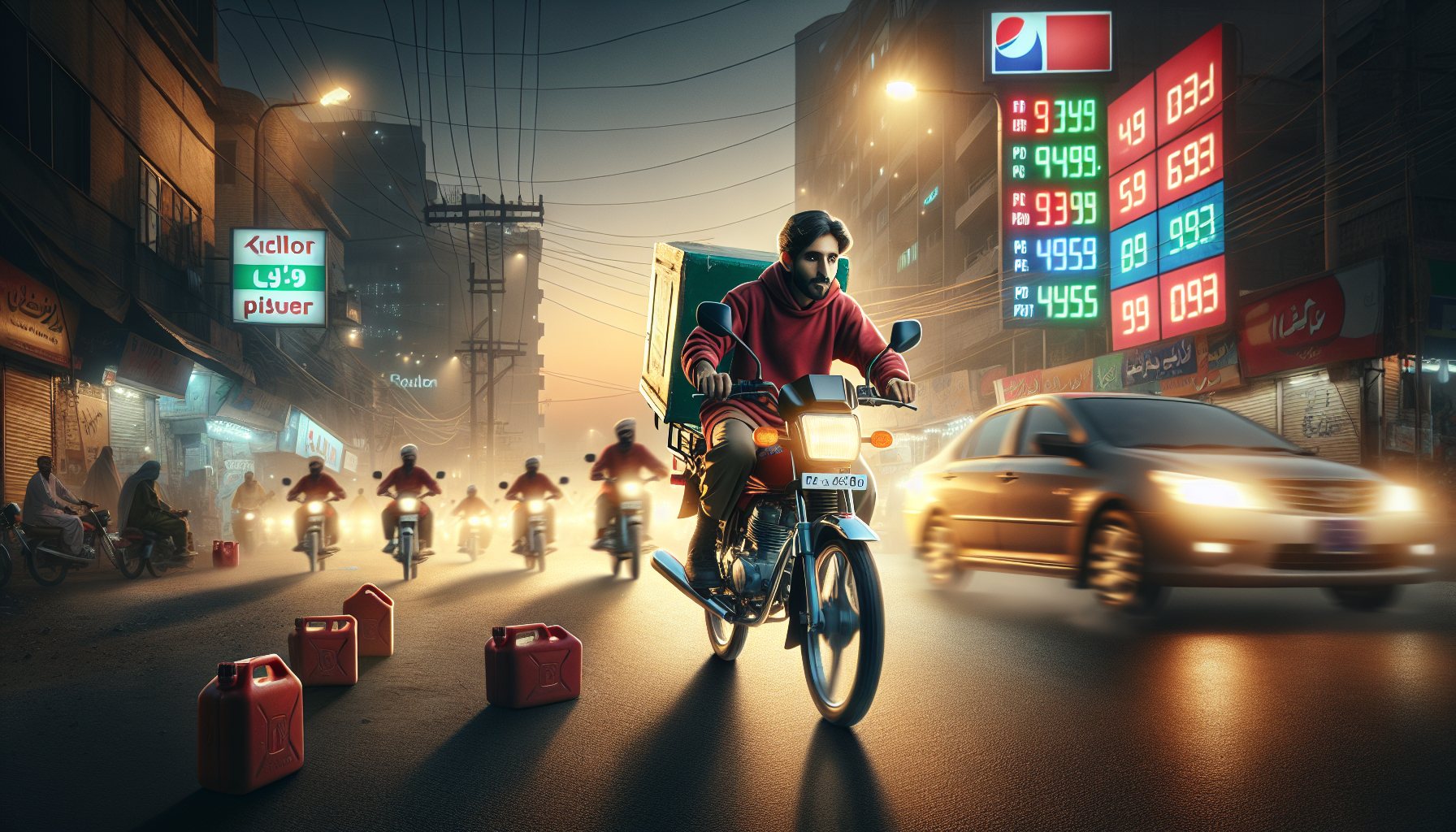
For 19-year-old delivery rider Ehsanullah, the sound of his motorcycle once symbolized freedom and opportunity. Hailing from Mardan, he has been working with a local food delivery service for the past year, initially viewing the gig economy as a reliable income source.
“When I started, everything was going smoothly,” he reflects. However, with Pakistan grappling with historic inflation and erratic fuel prices, the familiar hum of his bike now brings anxiety, each trip shadowed by financial uncertainty.
The main challenge for riders like Ehsanullah lies in the gap between company policies and the realities of their daily work. Delivery platforms impose fuel consumption limits, but these do not match the actual demands faced by riders.
“They set a monthly fuel limit of about 20 litres,” Ehsanullah explains. “But we use 20 litres in just four to five days.” Essentially, the fuel allowance intended for a month barely lasts a week, turning every kilometer ridden into a potential financial loss rather than a source of income.
Fuel prices fluctuate daily, adding to the difficulty. “Petrol prices change overnight; what costs one amount at night can rise by morning,” he says. Despite these increases, rider compensation remains fixed, forcing them to cover rising expenses for rent, food, bike upkeep, and mobile phone bills—essential tools for their work.
Muhammad Abdullah, a delivery rider from Chakwal who has been in the trade for nine years and also works in Islamabad’s real estate sector, shares similar concerns. He recalls that when he first moved to Islamabad, petrol was priced around 150 rupees per litre, and his daily commute from Rawalpindi was roughly 50 kilometers.
“Inflation steadily rose, and so did my daily expenses,” Abdullah notes. With a monthly salary of 40,000 rupees and fuel prices now at 458 rupees per litre, commuting has become prohibitively expensive. “My bike consumes about 1.25 litres daily, which costs 17,200 rupees a month. Managing household expenses alongside petrol costs has become extremely difficult,” he adds.
He also points out that government relief, offering a 100 rupee per litre discount, requires registration through a new app. Until this system is fully operational, many riders will continue to bear the burden of soaring fuel prices alone.
Beyond fuel, riders face other financial challenges. Tips, while occasionally helpful, are inconsistent. “Sometimes I get Rs50, other times Rs100; it depends on luck,” Ehsanullah explains. Small transaction losses also accumulate. “If a customer’s bill is Rs1,050 and they pay Rs2,000, we may not have Rs950 to return, so we often lose Rs50,” he says.
Weather conditions further complicate their work. Heavy rain can halt deliveries entirely, as riders risk damage to their bikes and phones, which are vital for their jobs. Without paid leave, a rainy day means no income.
Many riders, including Ehsanullah and Abdullah, support families back home. Rising living costs and fuel expenses have drastically reduced the money they can send to their households. “After covering all expenses, we can send very little home, making it hard for our families to survive,” Ehsanullah admits. Abdullah concurs, saying, “It has become very challenging to manage with my current salary. Every day is a struggle to make ends meet.”
The difficulties faced by these riders highlight a broader crisis affecting thousands of gig economy workers in Pakistan. As fuel prices surge and inflation impacts daily life, motorcycle-dependent delivery workers are among the most vulnerable.
Without adjustments to wages or timely subsidies, many fear their jobs will soon become unsustainable. For now, they continue to navigate the city streets, balancing orders, expenses, and hope. Ehsanullah voices a sentiment shared by many: “May Allah create some ease for us.”
