

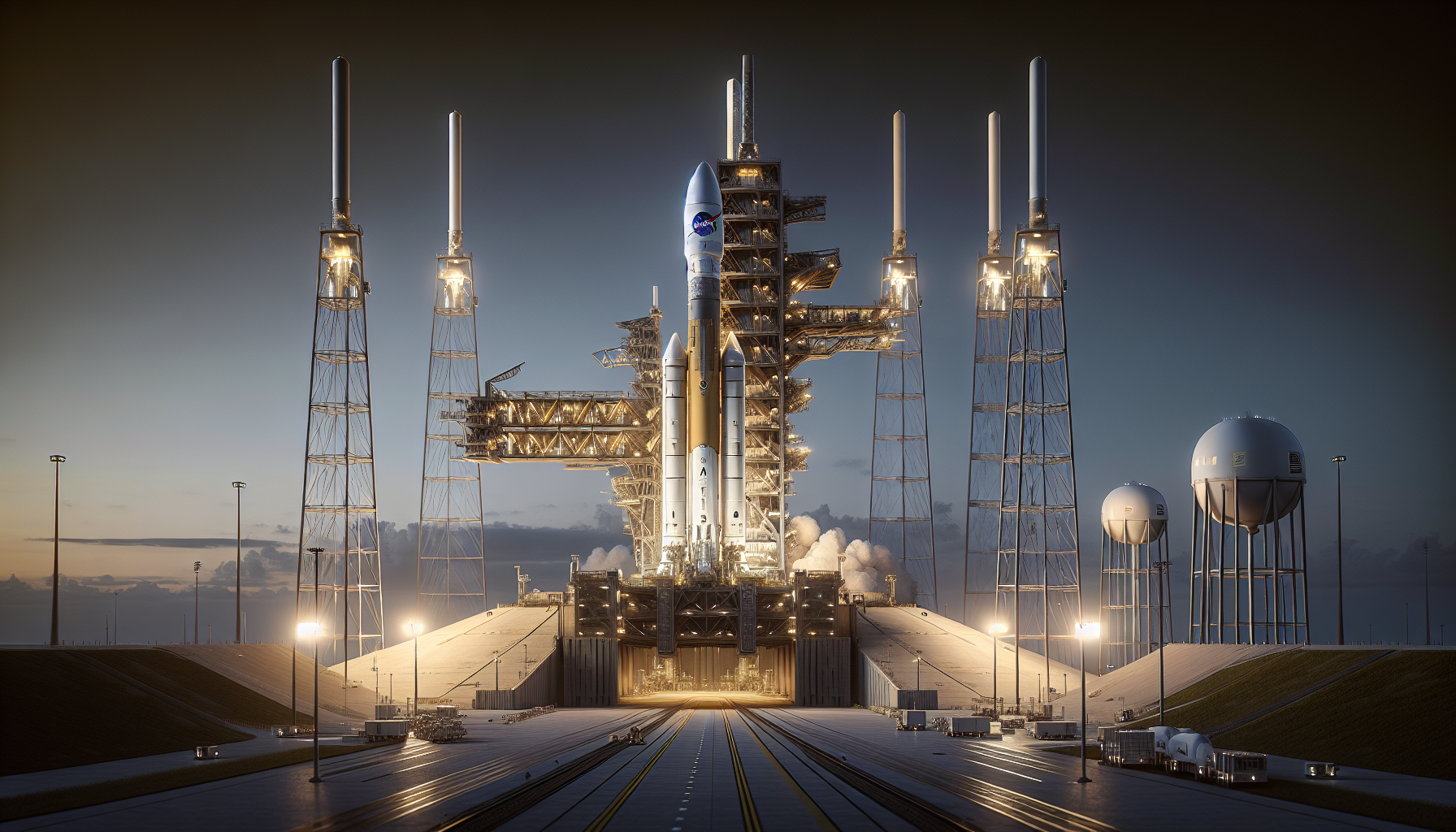
NASA is preparing to launch four astronauts on a 10-day mission around the moon as early as Wednesday evening, marking the most ambitious U.S. spaceflight in decades. This mission represents a crucial milestone in the agency’s efforts to return humans to the lunar surface ahead of China’s planned crewed landing.
Mission managers confirmed a “go” for the Artemis II launch, scheduled for 6:24 p.m. EDT (2224 GMT) on Wednesday. The towering 322-foot (98-meter) Space Launch System (SLS) rocket, topped with the Orion crew capsule carrying the astronauts, will lift off from NASA’s Kennedy Space Center in Florida. Notably, this launch pad is just one pad away from where the last Apollo astronauts departed for the moon more than 50 years ago.
The Artemis II crew consists of NASA astronauts Christina Koch, Victor Glover, Reid Wiseman, and Canadian astronaut Jeremy Hansen, who arrived in Florida from Houston on Friday. Approximately nine hours before liftoff, the crew began their day with breakfast, a weather briefing, and final pre-mission preparations before departing for the launchpad at 2 p.m. They have been in quarantine for two weeks leading up to the launch and spent time with their families over the weekend at the Kennedy Space Center’s beach house, a traditional resting place for astronauts before flight.
On Wednesday morning, NASA began fueling the SLS core stage with 733,000 gallons of super-cooled propellant to power the rocket’s four RS-25 engines. These engines, about the size of pickup trucks and built by Aerojet Rocketdyne, previously powered the Space Shuttle fleet for decades. Assistant launch director Jeremy Graeber reported that the fueling process was progressing smoothly.
Weather conditions appear favorable, with only a 20% chance of disruption during the two-hour launch window. Should weather or technical issues delay the launch, NASA plans to attempt liftoff again as soon as Friday, with further opportunities available until April 6. If necessary, the next launch window would open on April 30. Launch director Charlie Blackwell-Thompson expressed confidence in the preparations, stating the team is in “excellent shape” as the countdown proceeds.
The launch was initially targeted for February 6 and then March 6 but was postponed due to a hydrogen leak that required the rocket to be rolled back to the vehicle assembly building for inspection.
In a historic journey, Artemis II will send its crew on a nearly 10-day voyage around the moon and back, traveling approximately 252,000 miles (406,000 km) from Earth—the farthest distance humans have ever ventured into space. The current record is held by Apollo 13’s crew, who traveled roughly 248,000 miles in 1970 during a mission that was aborted due to an oxygen tank explosion.
Since the last Apollo mission in 1972, no humans have left Earth’s orbit. NASA’s Artemis I mission, launched in 2022, sent an uncrewed Orion spacecraft on a similar lunar orbit path. Artemis II will be a more rigorous test of both the Orion capsule and the SLS rocket, with astronauts evaluating critical life-support systems, crew interfaces, and communications.
Approximately three hours after launch, the crew will manually pilot Orion to test its steering and maneuverability, an essential capability in case automated systems fail. Lockheed Martin manufactures the Orion spacecraft, while Boeing and Northrop Grumman have led the SLS rocket’s development since 2010. The program has faced criticism for escalating costs, estimated between $2 billion and $4 billion per launch.
Meanwhile, private companies SpaceX and Blue Origin are competing to develop lunar landers that NASA will use to transport astronauts to the moon’s surface. Artemis II is a critical early phase of NASA’s multibillion-dollar Artemis program, which aims to establish a long-term human presence on the lunar south pole.
NASA is pushing to land astronauts on the moon by the Artemis IV mission in 2028, aiming to beat China’s anticipated crewed lunar landing around 2030. Originally, Artemis III was planned as the first crewed moon landing, but new NASA Administrator Jared Isaacman announced in February that an additional test mission would precede the landing.
