

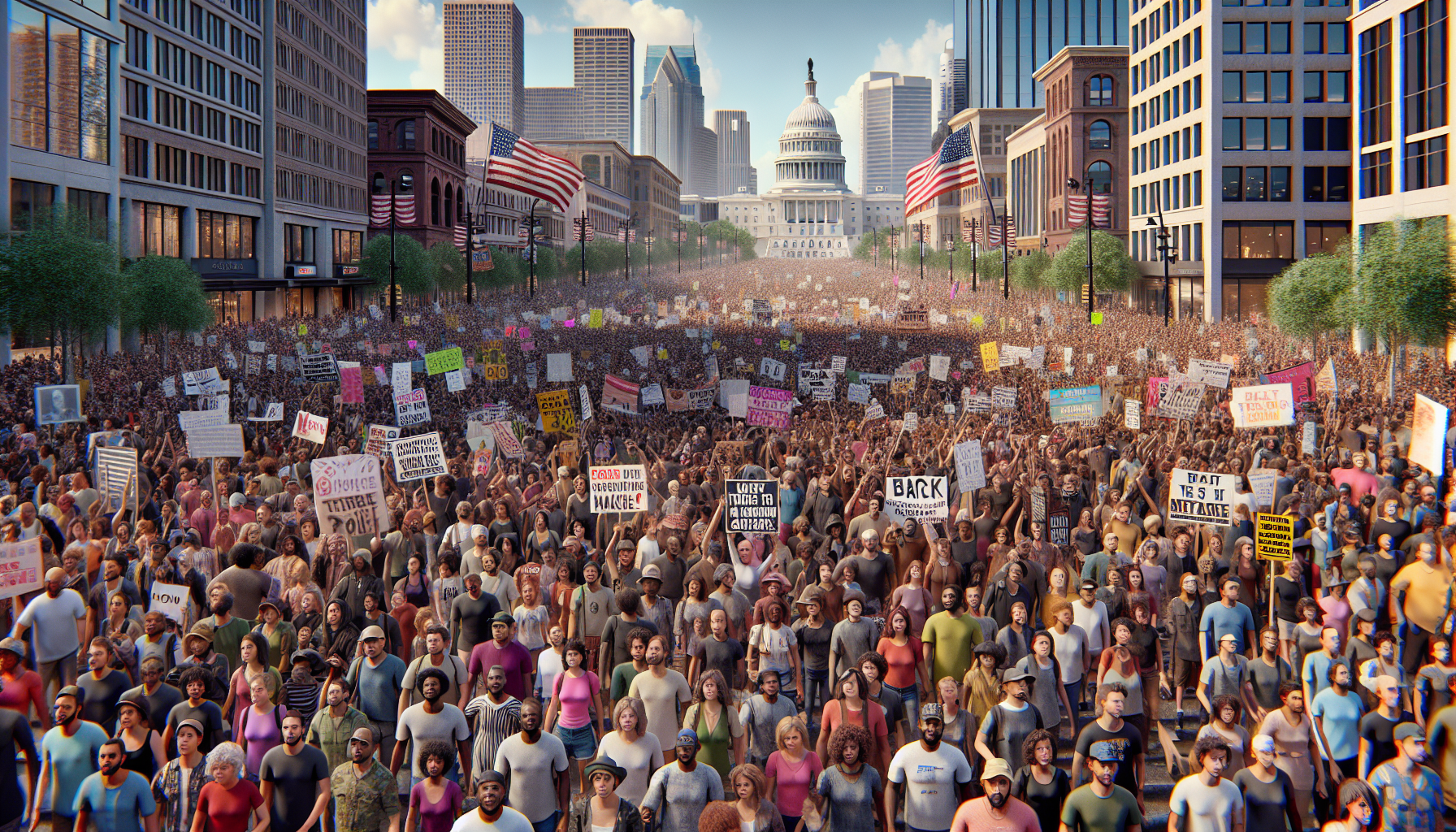
On Saturday, vast crowds gathered across the United States to protest against President Donald Trump, expressing strong opposition to his authoritarian governing style, stringent immigration policies, and escalating conflict with Iran. Organizers estimated that over 8 million people participated in more than 3,300 events spanning every state, from major urban centers to small towns, although no official national attendance figures were released.
This marked the third nationwide demonstration under the grassroots movement known as “No Kings,” which has become the most prominent platform for anti-Trump sentiment since he began his second term in January 2025. In New York City, tens of thousands joined the protests, including Oscar-winning actor Robert De Niro, who described Trump as “an existential threat to our freedoms and security.” Demonstrations also took place from Atlanta to San Diego, with participants from Alaska joining later in the day.
In Atlanta, 36-year-old military veteran Marc McCaughey emphasized the constitutional concerns driving the protests, stating, “No country can govern without the consent of the people. We’re out here because we feel that the Constitution is under threat in a multitude of different ways. Things aren’t normal. They aren’t okay.” Meanwhile, in West Bloomfield, Michigan, near Detroit, protesters endured freezing temperatures to make their voices heard.
Thousands marched in Washington, D.C., many carrying signs with slogans such as “Trump Must Go Now!” and “Fight Fascism” as they gathered at the National Mall. Retiree Robert Pavosevich, 67, voiced frustration over what he described as relentless dishonesty from the president, saying, “He keeps lying and lying and lying and lying, and no one says anything. So it’s a terrible situation we’re in.” Trump spent the weekend in Florida, away from the protests.
The anti-Trump demonstrations extended beyond the US, with rallies held in European cities including Amsterdam, Madrid, and Rome, where 20,000 people marched under heavy police supervision.
In a significant development, the first nationwide “No Kings” protest took place last June on Trump’s 79th birthday, coinciding with a military parade he organized in Washington, drawing several million participants from coast to coast. The second protest in October attracted an estimated seven million demonstrators, and organizers noted that Saturday’s events surpassed previous numbers by one million participants and added 600 more demonstrations.
Trump remains a polarizing figure, deeply admired by supporters of his “Make America Great Again” movement but equally opposed by others across the political spectrum. His approval rating has dropped below 40 percent as midterm elections approach in November, threatening Republican control of both Congressional chambers. Critics highlight his frequent use of executive orders, the Justice Department’s prosecution of political opponents, his focus on fossil fuels coupled with climate change denial, and his increasing military interventions despite campaigning as a peacemaker.
Naveed Shah of Common Defense, a veterans’ group linked to the “No Kings” movement, condemned the administration’s actions, stating, “Since the last time we marched, this administration has dragged us deeper into war. At home, we’ve watched citizens killed in the streets by militarized forces. We’ve seen families torn apart and immigrant communities targeted. All of it done in the name of one man trying to rule like a king.”
While protests occurred nationwide, Minnesota emerged as a focal point. The Twin Cities of Minneapolis and St. Paul have become central to the national debate over Trump’s aggressive immigration enforcement this winter. At the Minnesota rally, progressive politician Bernie Sanders addressed the crowd, declaring, “We will never accept a president who is a pathological liar, a kleptocrat and a narcissist who is undermining the Constitution of the United States and the rule of law every day.”
Adding to the event’s impact, legendary musician Bruce Springsteen performed his song “Streets of Minneapolis” in St. Paul, where tens of thousands gathered. Springsteen composed the protest ballad within 24 hours to honor Renee Good and Alex Pretti, two US citizens fatally shot by federal agents during January protests against Trump’s immigration crackdown. Before performing, Springsteen paid tribute to their courage and sacrifice, affirming, “Their bravery, their sacrifice and their names will not be forgotten.”
