

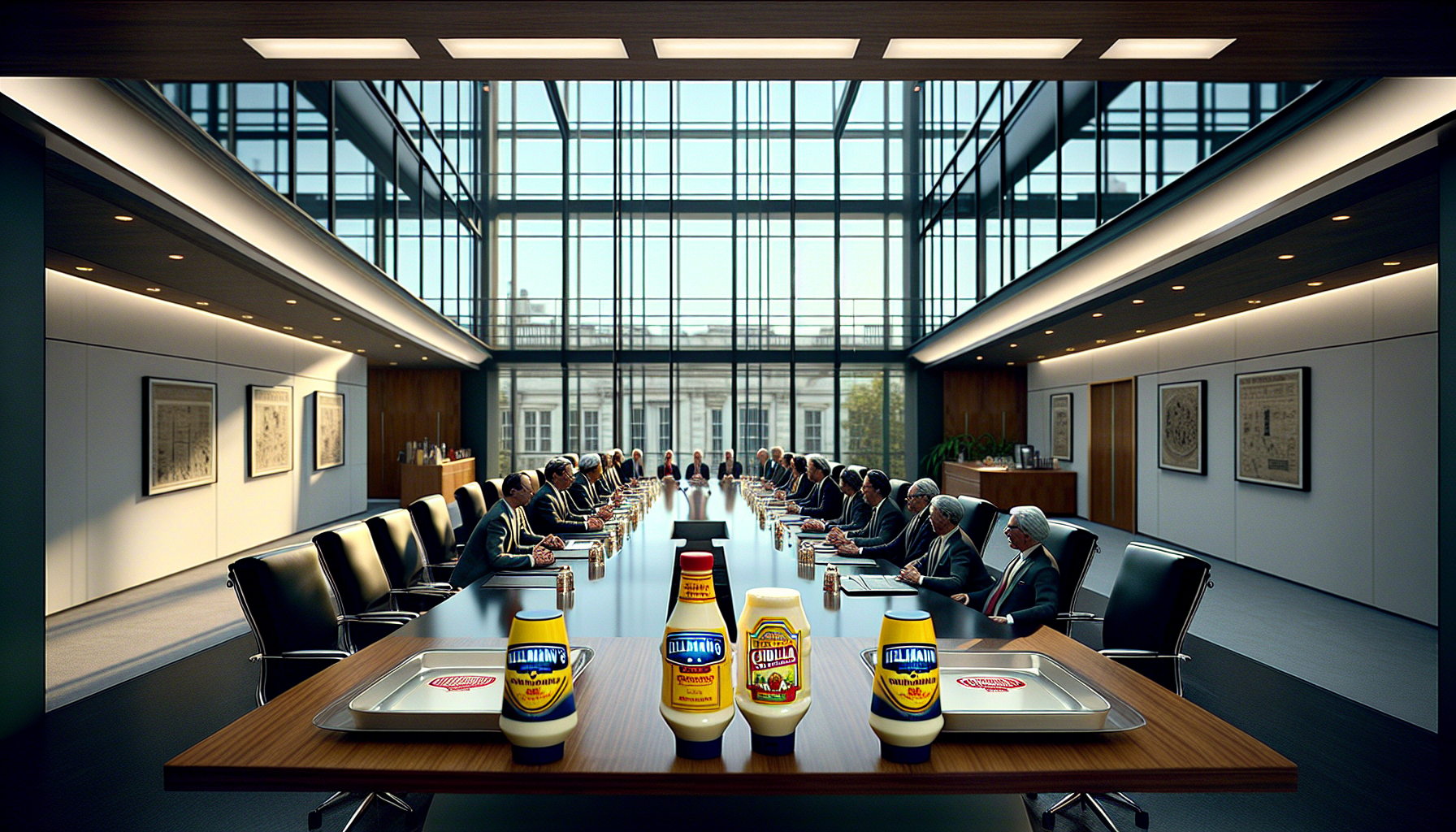
A proposed merger between Unilever’s food division and the US spice manufacturer McCormick would grant Unilever’s shareholders a majority stake in the combined company, along with tax benefits, sources familiar with the matter revealed. Unilever, known for brands like Hellmann’s mayonnaise and Knorr stock cubes, is among the world’s largest personal care and food companies.
Last week, Unilever confirmed it was in discussions with McCormick following an offer from the smaller firm to acquire its food business. McCormick, the maker of Cholula hot sauce, acknowledged the talks but did not disclose financial specifics. This deal could mark the most significant transformation at Unilever, which currently holds a stock market valuation of $131 billion.
Both companies are structuring the transaction to ensure that shareholders of the London-listed Unilever retain over 50% ownership in the new entity. This arrangement is designed to avoid triggering a change of control event, which would result in capital gains taxes. The deal would involve spinning off Unilever’s food business before its sale to Maryland-based McCormick, utilizing a reverse Morris trust (RMT) structure known for its tax efficiency.
Negotiations are advancing rapidly. While the exact stake for Unilever shareholders remains unclear, similar consumer goods transactions have typically resulted in sellers retaining between 50% and 60% ownership. For instance, in 2021, International Flavors & Fragrances acquired DuPont’s Nutrition & Biosciences unit through an RMT deal valued at $45.4 billion, with DuPont shareholders receiving 55.4% of the combined company. Earlier, J.M. Smucker’s acquisition of Jif, Crisco, and Folgers from Procter & Gamble also followed an RMT structure, granting P&G investors about 53% ownership in Smucker.
Barclays estimates Unilever’s food division is valued between 28 billion and 31 billion euros ($32 billion to $35 billion), including debt. McCormick’s enterprise value stands at nearly $18 billion, with approximately $4 billion in net debt, LSEG data. Such valuation disparities are typical in RMT deals, where the buyer is often smaller than the seller.
Unilever has enlisted Goldman Sachs for advisory support, with Morgan Stanley and PwC also involved in the potential spin-off. On the other side, McCormick is being advised by Citi and Rothschild. Both sides have declined to comment on the ongoing discussions.
McCormick has long admired Unilever’s food unit for its extensive global reach and the opportunity to develop undervalued brands within the conglomerate. The spice company has maintained a disciplined approach to mergers and acquisitions, enabling it to act swiftly when this opportunity arose. In recent years, McCormick attempted to acquire Duke’s mayonnaise maker Sauer Brands and Japanese barbecue sauce brand Bachan’s but was outbid. In 2017, it purchased Reckitt Benckiser’s food division, which included Frank’s RedHot hot sauce and French’s mustard.
Unilever recently completed the separation of its ice cream business, which was listed as The Magnum Ice Cream Company in December. Following that transaction, Unilever retained a 19.9% stake in Magnum. The deal also provided tax advantages, such as reduced chargeable gains for shareholders when part of their holdings were converted into Magnum stock.
