

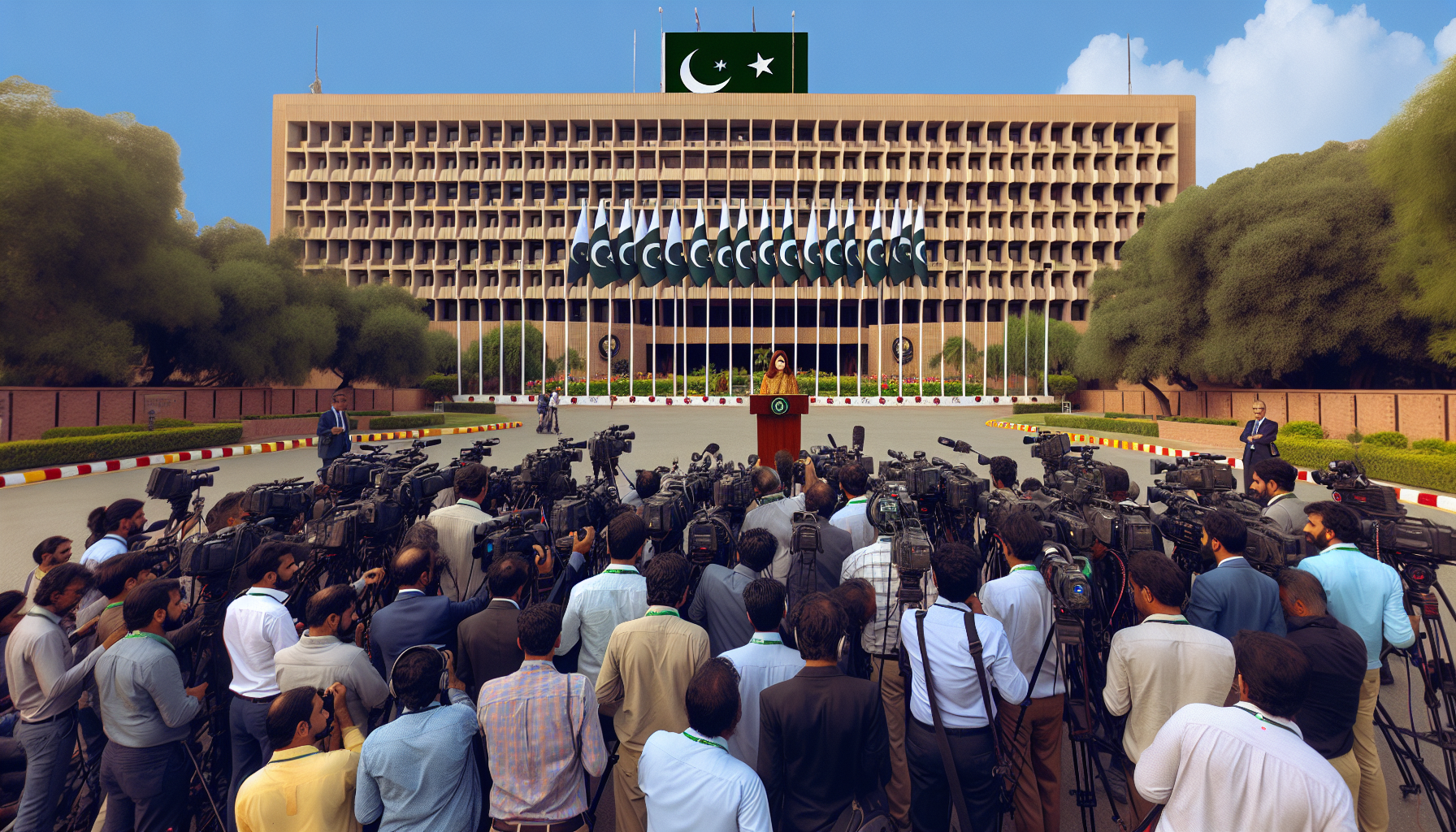
ISLAMABAD: The Foreign Office (FO) of Pakistan on Thursday strongly refuted recent allegations made by the United States Director of National Intelligence, Tulsi Gabbard, regarding Pakistan’s missile capabilities posing a potential threat. In a detailed statement, FO Spokesperson Tahir Hussain Andrabi underscored that Pakistan’s strategic arsenal is purely defensive, designed to protect its sovereignty and contribute to peace and stability in South Asia.
Responding to questions from the media about the US intelligence chief’s remarks, Andrabi clarified that Pakistan’s missile program remains well within the bounds of credible minimum deterrence, particularly in relation to its neighbor India. He emphasized that Pakistan’s missile range does not extend to intercontinental distances, countering the assertion that Islamabad’s capabilities could threaten the American homeland.
It is worth noting that the day before, during the presentation of the 2026 Annual Threat Assessment to the Senate Intelligence Committee, Tulsi Gabbard had singled out Pakistan as one of several countries raising strategic concerns for the United States. Alongside Iran, China, Russia, and North Korea, Pakistan was mentioned for its ongoing development of long-range missile systems, including those potentially capable of carrying nuclear or conventional warheads. Gabbard specifically suggested that Pakistan’s ballistic missile program might evolve to include intercontinental ballistic missiles (ICBMs), which could reach US territory.
In his rebuttal, the FO spokesperson stressed that Pakistan’s missile development is firmly anchored in a defensive doctrine aimed at maintaining regional balance, especially vis-à-vis India. Andrabi pointed out that India’s missile capabilities, which reportedly exceed 12,000 kilometers, raise broader security concerns that extend beyond South Asia. This contrast, he argued, highlights Pakistan’s commitment to restraint and responsible defense policies.
Meanwhile, the spokesperson reaffirmed Pakistan’s dedication to fostering constructive relations with the United States based on mutual respect, fairness, and factual dialogue. He called for a more nuanced and balanced approach from Washington, one that takes into account the strategic realities of South Asia and supports efforts to promote peace, security, and stability throughout the region.
In a related development, the Foreign Office’s statement reflects ongoing sensitivities surrounding Pakistan’s defense posture amid evolving geopolitical dynamics. The emphasis on credible minimum deterrence remains a cornerstone of Pakistan’s national security strategy, aimed at deterring aggression without escalating regional tensions.
As Islamabad continues to navigate complex international relations, the government’s clear message is that its military capabilities are not designed for offensive purposes but rather to ensure national sovereignty and regional equilibrium. This stance is critical in a region marked by historical rivalries and emerging security challenges.
