

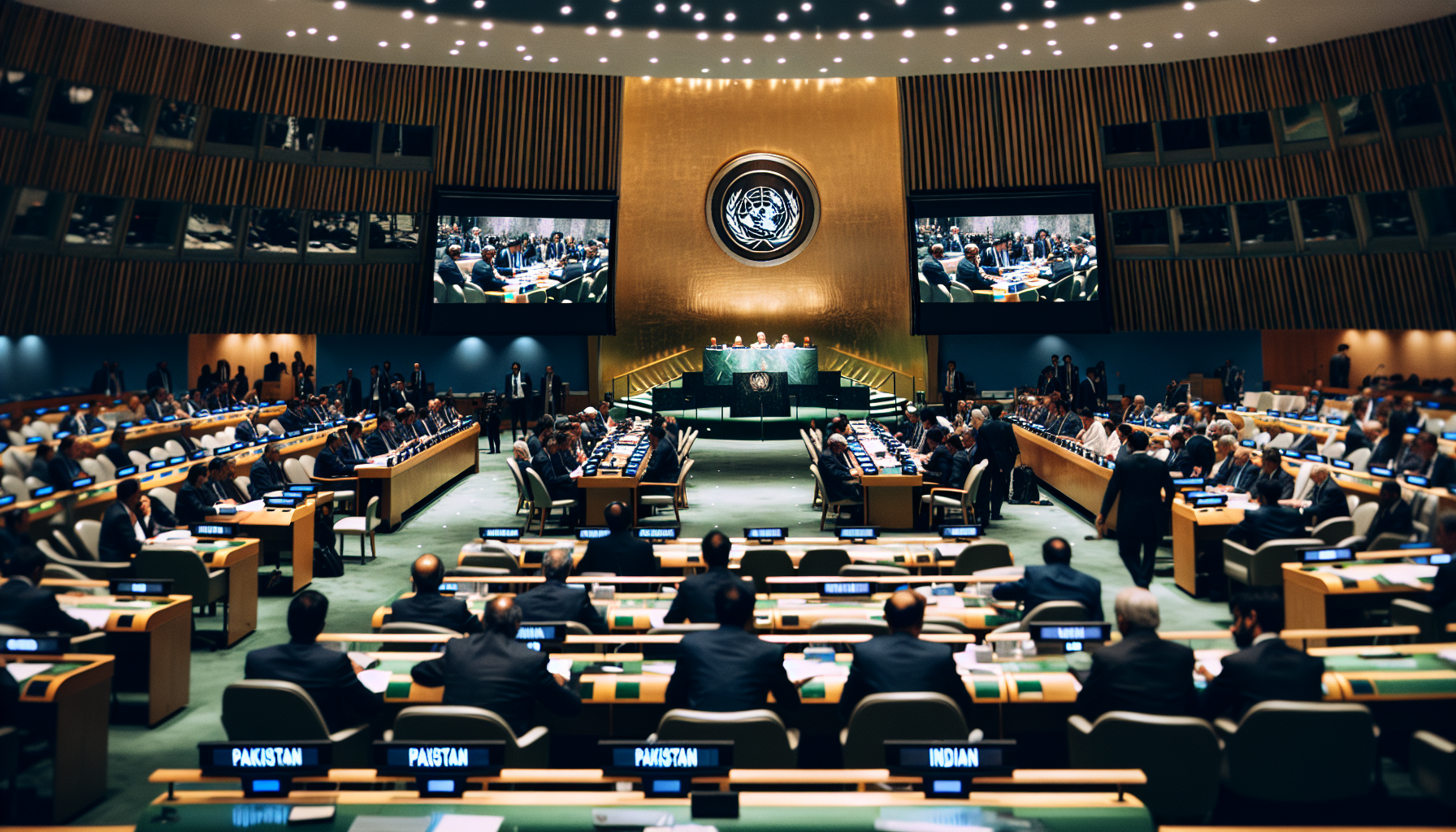
In a forceful response at the United Nations, Pakistan vehemently dismissed India’s recent accusations and criticized New Delhi for undermining the Indus Waters Treaty (IWT), accusing it of politicizing water resources for narrow political objectives. The confrontation unfolded during a high-level UN gathering commemorating World Water Day, which this year focused on the theme of water and gender equality. Pakistan’s Second Secretary, Aleena Majeed, took the floor to exercise her right of reply following contentious remarks made by the Indian representative.
During the session, the Indian envoy reiterated New Delhi’s stance of keeping the Indus Waters Treaty “in abeyance” until Pakistan undertakes credible and irreversible measures against terrorism. The Indian side further argued that due to evolving technological advancements, environmental changes, and demographic shifts, the decades-old treaty requires revision. They also claimed that previous efforts to engage Pakistan in discussions over modifications had failed to yield progress.
Responding firmly to these assertions, Aleena Majeed expressed her obligation to address what she described as unfounded and misleading allegations. She highlighted the resilience of the Indus Waters Treaty, signed in 1960, which has withstood multiple wars, political crises, and ongoing tensions between the two countries, including the protracted dispute over the Indian Illegally Occupied Jammu and Kashmir (IIOJK). Majeed underscored that India’s unilateral decision last April to place the treaty in abeyance represents a serious breach of its legal and historical commitments. She emphasized that the treaty contains no clause permitting any party to suspend or alter its terms unilaterally.
Warning against the dangerous precedent set by India’s actions, Majeed described this as the “weaponisation of water,” a tactic that jeopardizes the livelihoods of millions who depend on the Indus river system for agriculture, drinking water, and daily sustenance. She pointed to ongoing international legal proceedings, particularly referencing a 2025 supplemental award by the Court of Arbitration, which reaffirmed that the treaty remains fully valid and that its dispute resolution mechanisms are binding and operative. The ruling clearly stated that neither party has the authority to suspend or invalidate the treaty on their own, and Majeed urged India to immediately return to full compliance with its obligations under international law.
In a related development, she categorically rejected India’s terrorism allegations as entirely baseless and politically motivated. Majeed argued that these accusations are a deliberate attempt to divert attention from India’s own record of state-sponsored violence and cross-border provocations. She cited credible evidence pointing to India’s alleged support for militant groups responsible for attacks within Pakistan, which have resulted in significant loss of life. Furthermore, she condemned India’s ongoing state violence in occupied Jammu and Kashmir and alleged state-backed operations abroad, including in North America.
Reiterating Pakistan’s unwavering commitment to peaceful resolution and adherence to international treaties, Majeed affirmed that Pakistan firmly opposes any attempts to manipulate water resources as a political weapon. She concluded by emphasizing Pakistan’s dedication to upholding the Indus Waters Treaty in its true spirit, calling on India to respect the rule of law and engage constructively to ensure the sustainable management of shared water resources for the benefit of both nations.
