

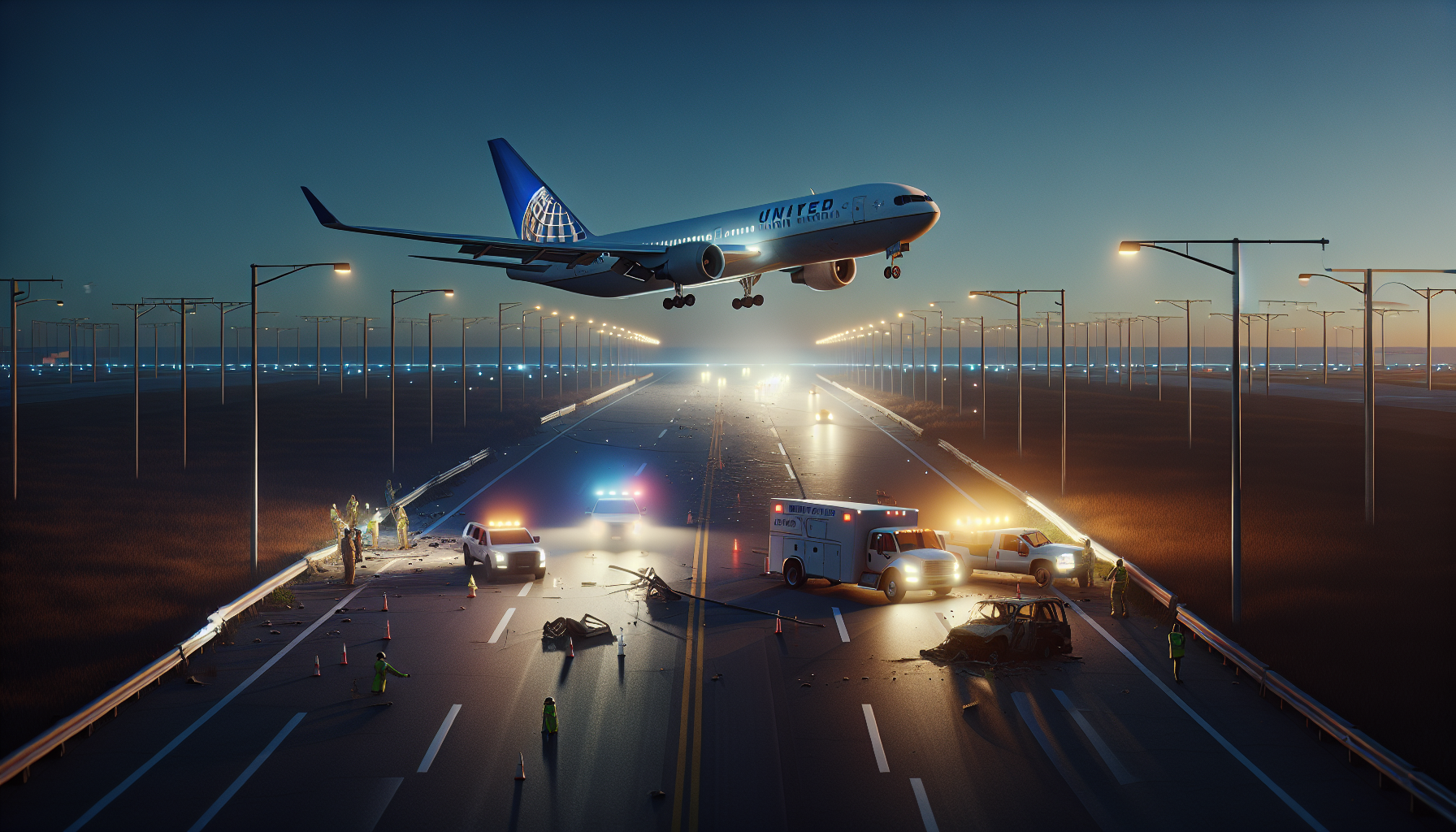
A United Airlines Boeing 767 passenger jet experienced an unusual ground collision while landing in New Jersey, striking a truck and a streetlight near the runway. Despite the incident, the aircraft, arriving from Venice, Italy, landed safely with all 231 passengers and crew unharmed.
Initial information reveals that one of the plane’s tires made contact with a truck positioned close to the runway, damaging the vehicle’s window and windshield. The truck driver suffered cuts to the arm and hand from shattered glass and received treatment at the scene.
The airline has initiated a comprehensive internal investigation and temporarily suspended the involved flight crew pending the review’s outcome. Technical teams are currently evaluating the damage sustained by the aircraft.
In a significant development, the National Transportation Safety Board has launched a formal inquiry into the collision. Officials have requested the cockpit voice recorder and flight data recorder to reconstruct the events leading up to the impact.
Authorities have yet to clarify how the truck entered the aircraft’s path, with further details expected as the investigation advances.
Meanwhile, this incident at Newark has drawn immediate parallels to the tragic Air Canada Express crash at LaGuardia Airport just over a month ago. In March 2026, a Bombardier CRJ900 arriving from Montreal collided at high speed with a Port Authority fire truck crossing the runway. That accident resulted in the deaths of both pilots and injuries to several passengers, marking one of the most severe runway incursions in recent memory.
Notably, the fire truck involved in the LaGuardia crash was responding to a separate emergency involving a United Airlines aircraft at the time, adding a grim layer of irony to these back-to-back events in the New York area.
These consecutive incidents have heightened scrutiny on ground safety measures and air traffic control communications. As investigators probe how the United 767 clipped a vehicle near the New Jersey Turnpike, the aviation sector remains vigilant, confronting a concerning pattern of near-misses and collisions between aircraft and ground vehicles.
