

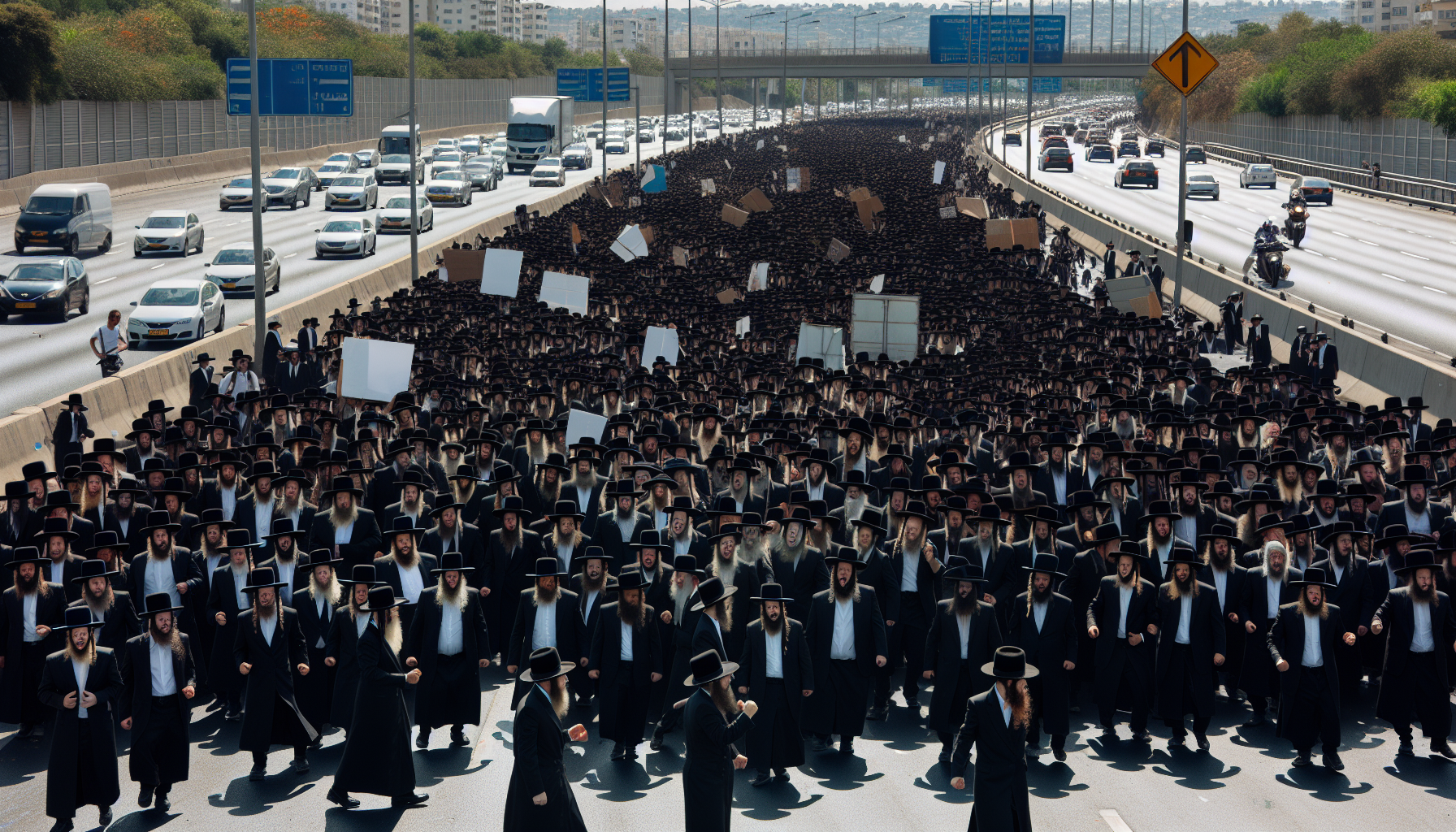
In a significant development, hundreds of Ultra-Orthodox Jewish protesters gathered to block a major road in Israel, voicing their opposition to the country’s compulsory military service. This demonstration highlights the ongoing tension between the Israeli government and the Ultra-Orthodox community, which has historically sought exemptions from conscription due to religious commitments. The protest underscores the community’s resistance to integration into the national military framework, which they argue conflicts with their religious lifestyle and studies.
Mandatory military service in Israel applies to most citizens, but the Ultra-Orthodox population has long been granted deferments, a policy increasingly scrutinized amid changing social and political dynamics. The government’s efforts to enforce broader conscription have sparked repeated protests, reflecting deeper societal debates about equality, national duty, and religious freedom. These demonstrations often disrupt daily life and highlight the challenges of balancing diverse community interests within Israel’s democratic framework.
Meanwhile, the protest’s impact extends beyond the immediate disruption of traffic, as it draws attention to the broader discourse on civil-military relations and minority rights in Israel. The Ultra-Orthodox community’s stance continues to influence political negotiations and policymaking, making this issue a persistent flashpoint in Israeli society. The ongoing protests serve as a reminder of the complex interplay between religion, state policy, and social cohesion in one of the world’s most politically sensitive regions.
