



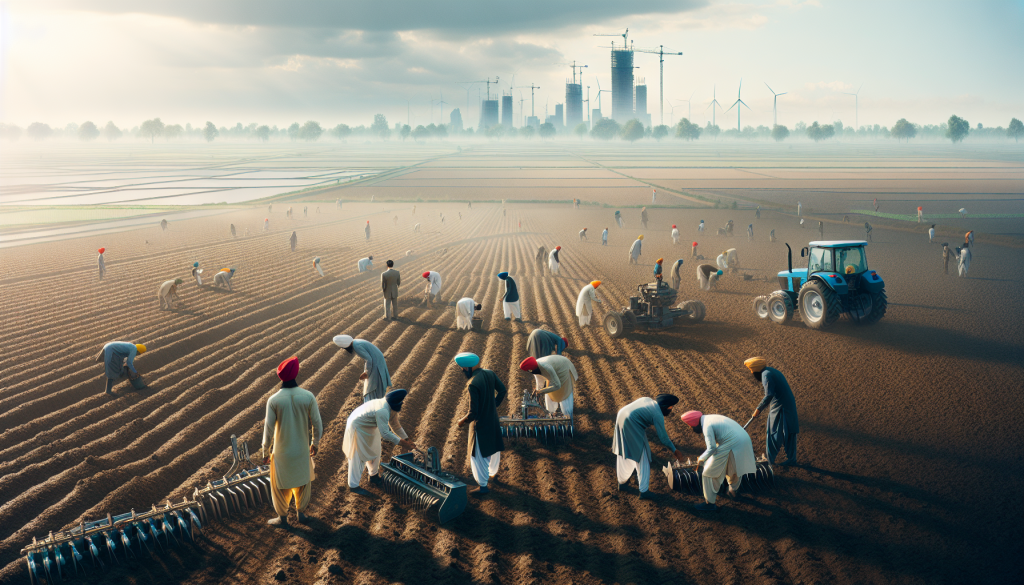
The Punjab government has unveiled a new initiative to lease agricultural land valued at Rs160 billion, targeting the revival of farming activities and job creation. Provincial Information Minister Azma Bukhari announced the programme, named “Apna Khet Apna Rozgar” (own farm, own livelihood), which will bring barren land under cultivation by leasing it to farmers for a period of 10 years.
Under this scheme, the leased land will be exclusively used for agricultural purposes, and beneficiaries will receive expert guidance to enhance farming practices. The initiative is expected to benefit over 88,000 families, providing them with sustainable livelihoods.
Bukhari highlighted that the programme aims to generate employment opportunities and bolster the provincial economy as part of a broader strategy to modernize Punjab’s agriculture sector. She also noted that the provincial government, led by Chief Minister Maryam Nawaz, has introduced several development projects, including farmer support schemes such as Kisan cards and subsidized tractors.
In addition to agricultural reforms, the government has allocated 50 acres for the development of a film city equipped with modern studios and production facilities, signaling diversification in economic activities.
Meanwhile, in a separate meeting chaired by Chief Minister Maryam Nawaz, officials reported that over 1.6 million people have benefited from various welfare schemes, including ration cards, Himmat cards, and minority cards. More than one million differently-abled individuals have received assistance through the Himmat card programme, with plans to extend financial support to an additional 200,000 people in the upcoming fiscal year.
Furthermore, monthly financial aid has been provided to over 1.4 million low-income individuals via ration cards. Maryam Nawaz instructed relevant authorities to expand social welfare initiatives, including a mass wedding programme aimed at 9,000 couples, and to enhance services for vulnerable groups such as women, children, and orphaned minors.
She emphasized that the primary goal is the welfare and support of the common citizen, adding that the social welfare department will be restructured to become more accessible and efficient, inspired by European models.

Leave an opinion