



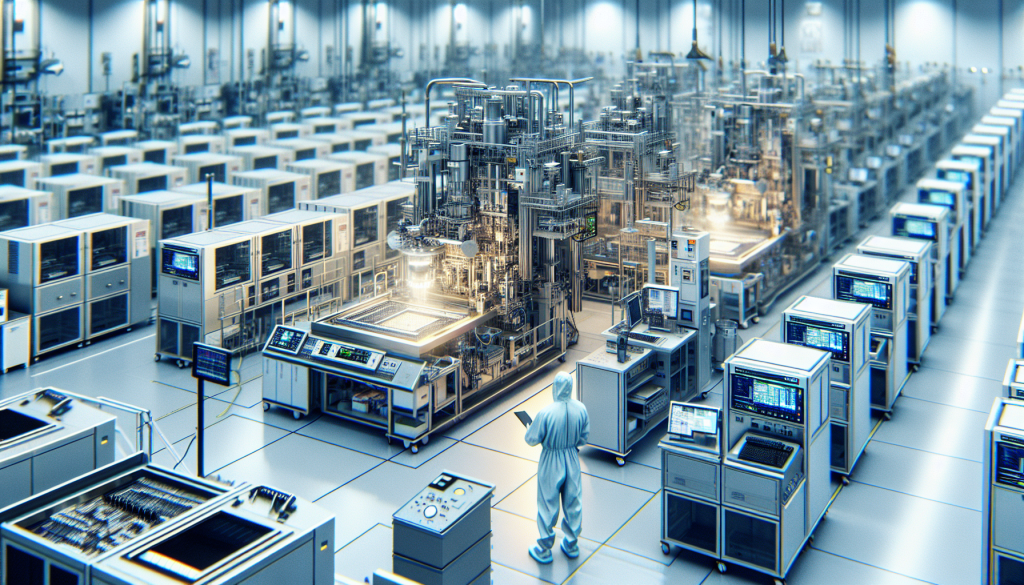
Taiwan Semiconductor Manufacturing Company (TSMC) announced on Thursday that it does not anticipate any near-term disruptions to its supply of critical chipmaking materials, including helium and hydrogen, despite the ongoing conflict in the Middle East. Chief Financial Officer Wendell Huang emphasized that the company sources these materials from multiple suppliers across various regions and maintains a safety stock inventory to mitigate potential risks.
In a significant development, TSMC revealed that its net profit for the first quarter of 2026 surged to a record NT$572.5 billion ($18 billion), marking a 58.3 percent increase compared to the same period last year. This figure exceeded analyst expectations, which had forecasted NT$540.20 billion. The robust earnings were largely fueled by soaring demand for artificial intelligence (AI) hardware, as governments and technology giants invest heavily in new data centers to support AI applications such as chatbots, image generators, and task-executing agents.
TSMC, the world’s largest contract manufacturer of microchips used in devices ranging from Apple smartphones to Nvidia’s AI processors, benefits from its pivotal role in the AI supply chain. Industry experts note that the company’s advanced-node chip production, which represents the cutting edge of semiconductor manufacturing, is operating at full capacity. Ian Lyall of Proactive Investors highlighted that TSMC is supplying chips not only for AI accelerators but also for next-generation smartphones and the rapid expansion of data centers, which has surprised even the most optimistic market observers.
Meanwhile, the depreciation of the Taiwanese dollar has further enhanced TSMC’s revenue from international sales. The company reported net revenue of NT$1.13 trillion for the first quarter, reflecting a 35.1 percent year-on-year increase.
Despite these strong results, UBS analysts cautioned that consumer demand might weaken due to higher prices driven by a global memory chip shortage linked to the AI boom. They also noted that while cloud AI demand remains strong, supply constraints could limit TSMC’s growth potential this year. The analysts acknowledged that tensions in the Middle East add an element of macroeconomic uncertainty but expect AI-related spending to remain resilient unless the conflict becomes prolonged.
Regarding concerns about helium supply—a critical component in chip manufacturing—UBS analysts predicted minimal disruption. Qatar, a major helium producer affected by the Middle East war, has not yet impacted TSMC’s material supply, which the company confirmed remains stable for the foreseeable future.

Leave an opinion