

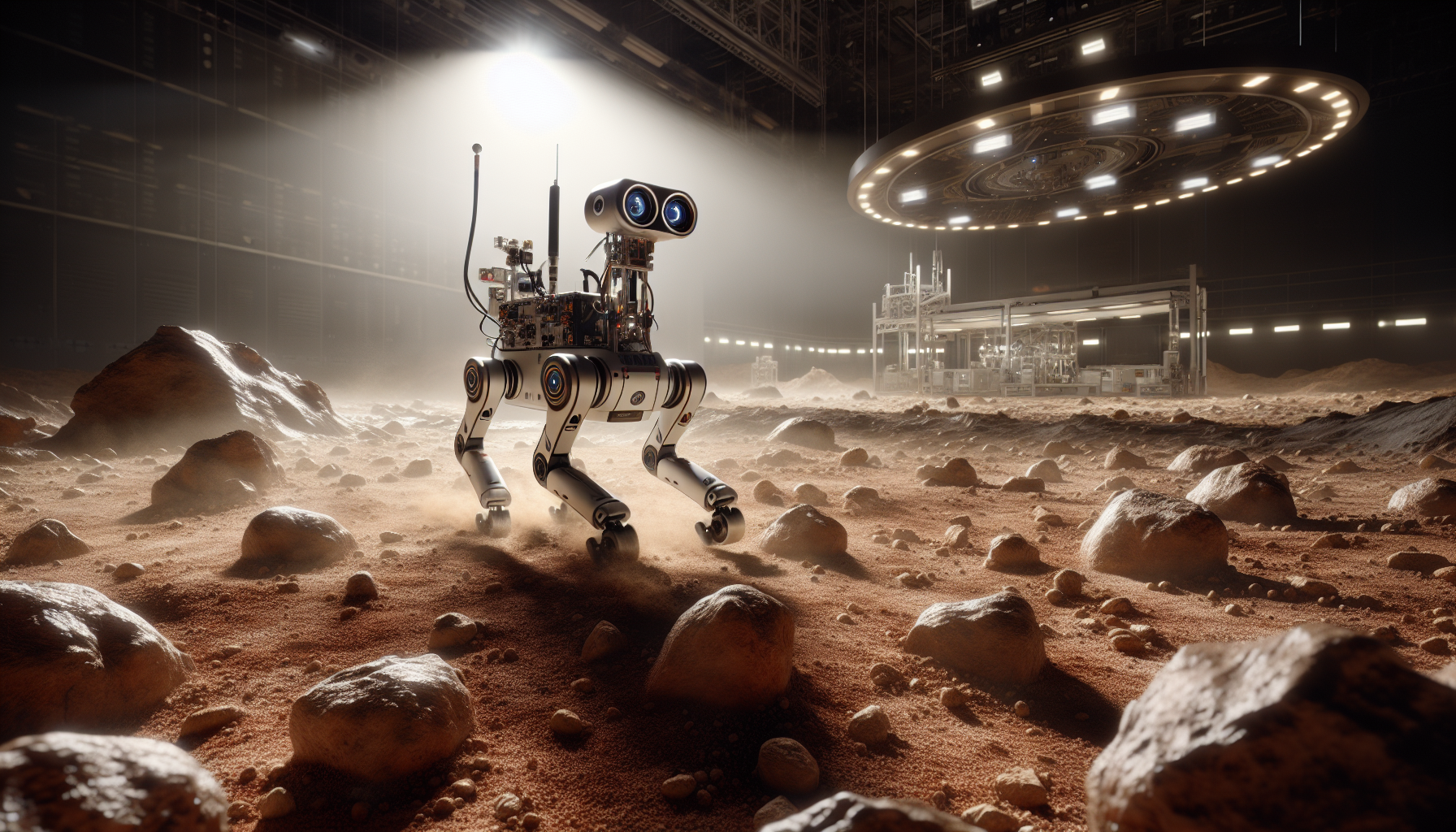
Swiss scientists have developed a semi-autonomous, quadruped robot designed for space exploration, with a focus on Mars missions. This innovative robot aims to accelerate the discovery of minerals, water, and potential signs of ancient life on other planets or exoplanets by operating independently, without the need for continuous human control.
In recent tests, the robot completed its tasks three times faster than comparable missions directed by humans. The trials took place at the University of Basel’s “Marslabor,” a specialized simulation facility replicating the dusty, rocky landscapes of Mars and the Moon. The robot, named ANYmal, resembles a robotic dog rather than a traditional wheeled rover and is equipped with advanced scientific instruments.
ANYmal carries a robotic arm fitted with a microscopic imager and a Raman spectrometer, which can analyze and identify the chemical composition of rocks. Its mission was to autonomously navigate the simulated Martian environment, locate scientifically valuable rocks, conduct analyses using its instruments, and transmit the findings without human intervention.
The robot demonstrated remarkable efficiency, completing autonomous missions in just 12 to 23 minutes, compared to the 41 minutes required when guided by a human operator. The experiments, published in Frontiers in Space Technologies, involved sequentially analyzing multiple rock samples and identifying a variety of materials, including soft sulfate minerals, gypsum carbonates, basalts, and lunar analogs such as dunite and anorthosite.
While autonomous operation was notably faster, human supervision produced slightly more accurate and detailed results. Currently, Mars rovers are operated under near-constant Earth-based control, covering only about a hundred meters daily. The use of autonomous robots like ANYmal could significantly speed up planetary exploration by enabling independent scientific decision-making.
In a significant development, the study also emphasizes the advantages of legged robots, which can traverse difficult and uneven terrain filled with obstacles—areas that wheeled rovers struggle to access. This research points toward a future where robots like ANYmal will not only act as remote-controlled tools but also as autonomous scientific explorers, capable of independently searching for biosignatures and chemical traces indicative of ancient life on distant worlds.
