



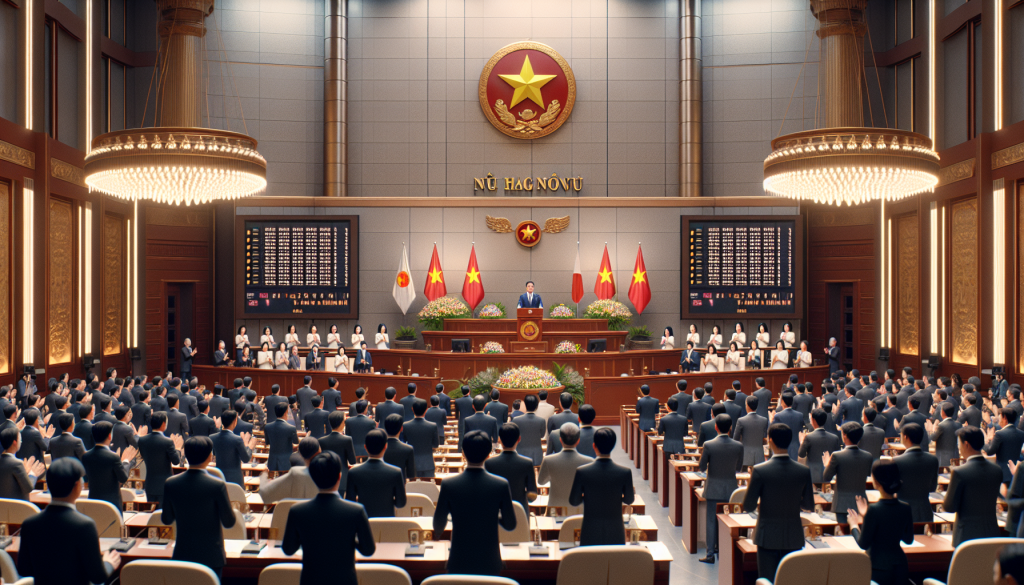
Vietnam’s National Assembly unanimously elected Communist Party Secretary General To Lam as the country’s state president on Tuesday, granting him a five-year term and making him the most powerful Vietnamese leader in decades. This widely expected decision marks a departure from Vietnam’s traditional collective leadership model, centralizing authority in a single figure. Analysts suggest this shift could steer the one-party state toward increased authoritarianism while enabling swifter decision-making, akin to the governance style of neighboring China.
All 495 deputies present at the National Assembly session endorsed the Communist Party’s nomination, with five lawmakers absent. The nominations for the top state leadership roles were finalized during a meeting held in late March. To Lam, who previously headed public security, now holds a dual mandate after securing a second term as general secretary in January. Later on Tuesday, the parliament is set to elect a new prime minister to succeed the outgoing Pham Minh Chinh.
Following his election, Lam addressed the deputies in a televised speech, expressing honor in holding both positions simultaneously. He pledged to implement a new growth model driven primarily by science, technology, innovation, and digital transformation. Additionally, he emphasized prioritizing self-reliance in national defense. Lam outlined his main objectives as maintaining stability, fostering rapid and sustainable development, and enhancing all aspects of citizens’ lives.
Experts note that Lam’s combined roles could facilitate the realization of his ambitious goals, though they warn about the dangers of concentrating too much power. Le Hong Hiep, a senior fellow at the ISEAS Yusof Ishak Institute in Singapore, remarked that this power consolidation might increase authoritarian tendencies but could also allow Vietnam to formulate and execute policies more efficiently, thereby supporting economic growth. Alexander Vuving from the Asia-Pacific Center for Security Studies in the United States observed that this dual role represents a new political norm in Vietnam, rendering previous assumptions about collective leadership obsolete.
Lam briefly held both positions following the death of former party General Secretary Nguyen Phu Trong in 2024. Although he later ceded the presidency to army general Luong Cuong, Lam continued to act as if he retained the role, frequently traveling and representing Vietnam in meetings with foreign leaders.
During his initial term as party chief, 68-year-old Lam initiated broad economic reforms aimed at enhancing Vietnam’s competitiveness, which received mixed reactions. He has committed to achieving double-digit growth through a development model less dependent on low-cost manufacturing, which has long been the foundation of Vietnam’s export-driven economy dominated by foreign multinationals. While his reforms have occasionally unsettled government officials and businesses, Lam has demonstrated pragmatic flexibility in their implementation.
Lam supports the growth of private conglomerates but also reaffirmed the dominant role of state-owned enterprises before his reappointment, seeking to reassure party traditionalists. Foreign investors, vital to Vietnam’s export economy, generally view Lam as a pro-business leader due to the country’s political stability under his leadership. However, his promotion of national champions and rapid growth ambitions have raised concerns about favoritism, corruption risks, asset bubbles, and inefficiency.
On the international front, Lam has maintained Vietnam’s “Bamboo Diplomacy,” balancing relations with major powers while expanding global partnerships. Khang Vu, a visiting scholar at Boston College, noted that despite concerns over power concentration, Lam’s dual role is unlikely to alter Vietnam’s foreign policy direction.

Leave an opinion