

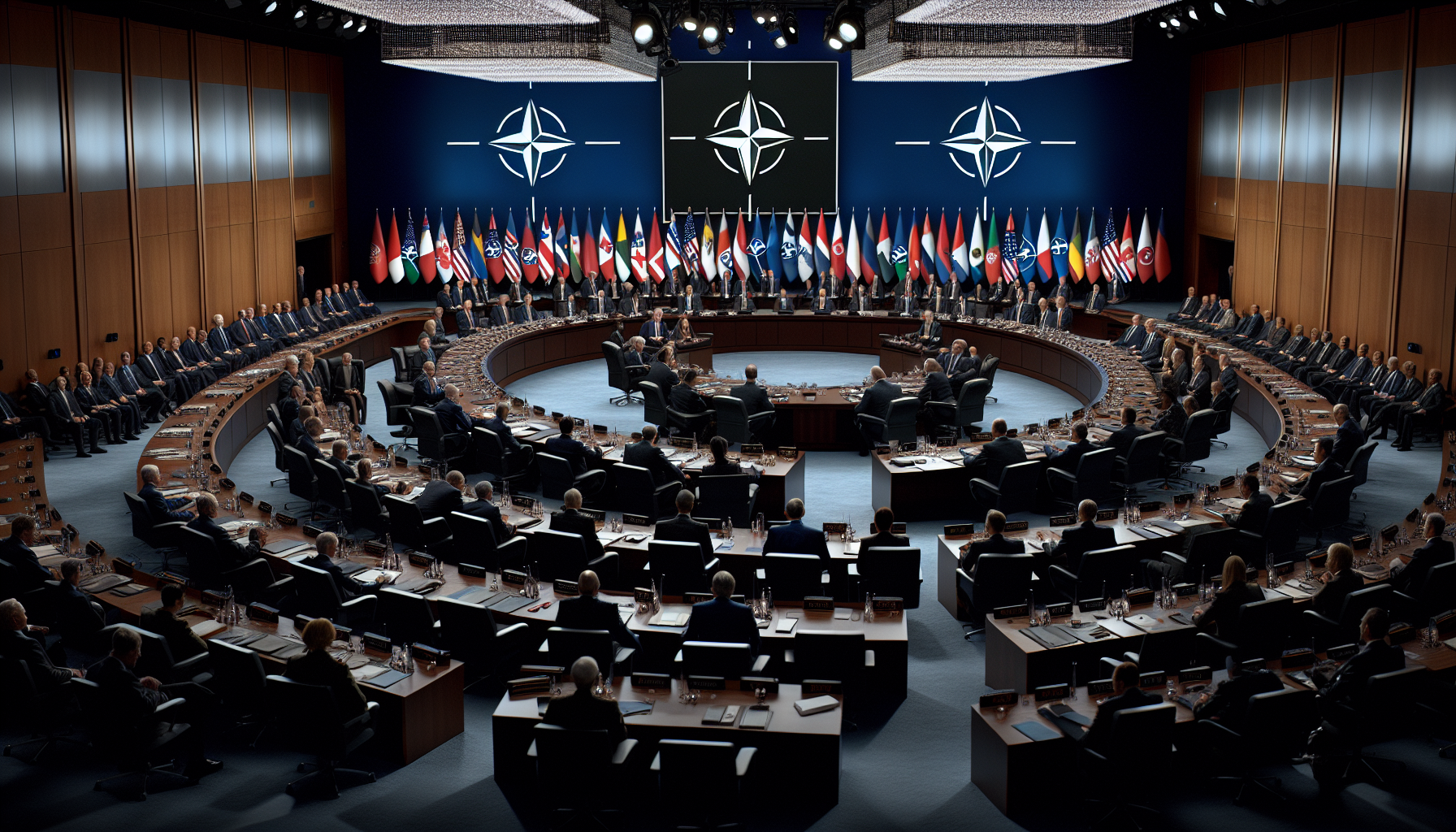
The NATO alliance, which has weathered numerous challenges including the war in Ukraine and repeated provocations from former U.S. President Donald Trump, now faces a potentially unprecedented crisis triggered by the U.S.-Israeli conflict with Iran. Despite being thousands of miles from Europe, this conflict has brought the 76-year-old bloc to the brink of its weakest state since its inception, analysts and diplomats.
Trump expressed frustration over European nations’ refusal to deploy their navies to secure the Strait of Hormuz following the air war’s commencement on February 28. In a Wednesday interview, he indicated he was contemplating withdrawing the United States from NATO, rhetorically asking, “Wouldn’t you if you were me?” Although his speech that evening criticized U.S. allies, he stopped short of outright condemning NATO, contrary to some expectations. Nevertheless, his recent remarks have fueled unprecedented concerns that the U.S. might not defend its European allies if attacked, regardless of whether Washington formally exits the alliance.
This situation has led to growing doubts about the mutual defense pact that forms NATO’s foundation, with many viewing it as no longer guaranteed. Max Bergmann, former State Department official and head of the Europe, Russia, and Eurasia Program at the Center for Strategic and International Studies, described the current state as “the worst place NATO has been since it was founded,” emphasizing the severity of the crisis.
European nations, long reliant on NATO as a shield against an increasingly assertive Russia, are now confronting a harsh reality. As recently as February, NATO Secretary-General Mark Rutte dismissed the idea of Europe defending itself without U.S. support as “silly.” However, many officials now consider European self-reliance the default assumption. General Francois Lecointre, France’s former armed forces chief, suggested that even the alliance’s name—North Atlantic Treaty Organization—might warrant reconsideration in light of these developments.
White House spokeswoman Anna Kelly reiterated that President Trump has made his dissatisfaction with NATO and other allies clear, emphasizing that “the United States will remember.” Meanwhile, NATO has yet to issue an immediate response to the unfolding situation.
Unlike previous challenges, including Trump’s first term from 2017 to 2021 when he also threatened withdrawal, this crisis appears more acute. Earlier, many European officials believed Trump could be placated through diplomacy and ceremony, but confidence in that approach has waned. The U.S. administration’s frustration stems from NATO’s perceived reluctance to assist the U.S. in critical moments, such as not supporting operations to secure the Strait of Hormuz and restricting U.S. access to certain airfields and airspace. U.S. officials argue that NATO cannot function as a “one-way street,” while European counterparts counter that no formal U.S. requests for specific assets have been made and complain about Washington’s inconsistent stance on mission timing.
Jamie Shea, a former senior NATO official, described the situation as “terrible” for the alliance, noting it undermines the efforts of allies who have sought to assume greater responsibility for their own defense since Trump’s return to the White House.
Trump’s recent statements come amid other signs of strain, including his January threats to seize Greenland from Denmark and U.S. actions perceived by Europeans as accommodating toward Russia. These include reports of Moscow providing targeting data to Iran for attacks on U.S. assets in the Middle East and the lifting of sanctions on Russian oil to ease global energy prices during the war. At a recent G7 foreign ministers meeting near Paris, a tense exchange occurred between U.S. Secretary of State Marco Rubio and EU foreign policy chief Kaja Kallas, highlighting the growing transatlantic rift. Kallas questioned U.S. patience with Russian President Vladimir Putin over Ukraine peace talks, prompting Rubio to emphasize U.S. efforts to end the war while supporting Ukraine, suggesting the EU could mediate if it wished.
Legally, Trump faces significant barriers to withdrawing the U.S. from NATO, as a 2023 law requires two-thirds Senate approval for such a move—a highly unlikely outcome. However, as commander-in-chief, he retains the authority to decide whether U.S. forces will defend NATO members, and refusal to do so could jeopardize the alliance without formal withdrawal.
Not all observers view the current turmoil as existential. Some, including a French diplomat, regard Trump’s rhetoric as a temporary outburst. His stance on NATO has shifted before; in 2024, he suggested encouraging Putin to attack NATO members not meeting defense spending commitments. Yet by the June 2025 NATO summit, Trump praised European leaders warmly. NATO Secretary-General Rutte, who maintains a strong rapport with Trump, plans a visit to Washington next week to attempt to alter the president’s perspective once again.
Despite doubts about U.S. commitment, analysts stress the importance of keeping America engaged in NATO, given its unique military capabilities such as satellite intelligence that are difficult to replace. Even if the alliance endures, many agree that the transatlantic partnership central to the post-World War II global order is undergoing a profound transformation. Julianne Smith, U.S. ambassador to NATO under President Joe Biden, remarked, “We’re on the cusp of something that’s going to have a different look and feel to it,” signaling a new era in transatlantic relations.
