

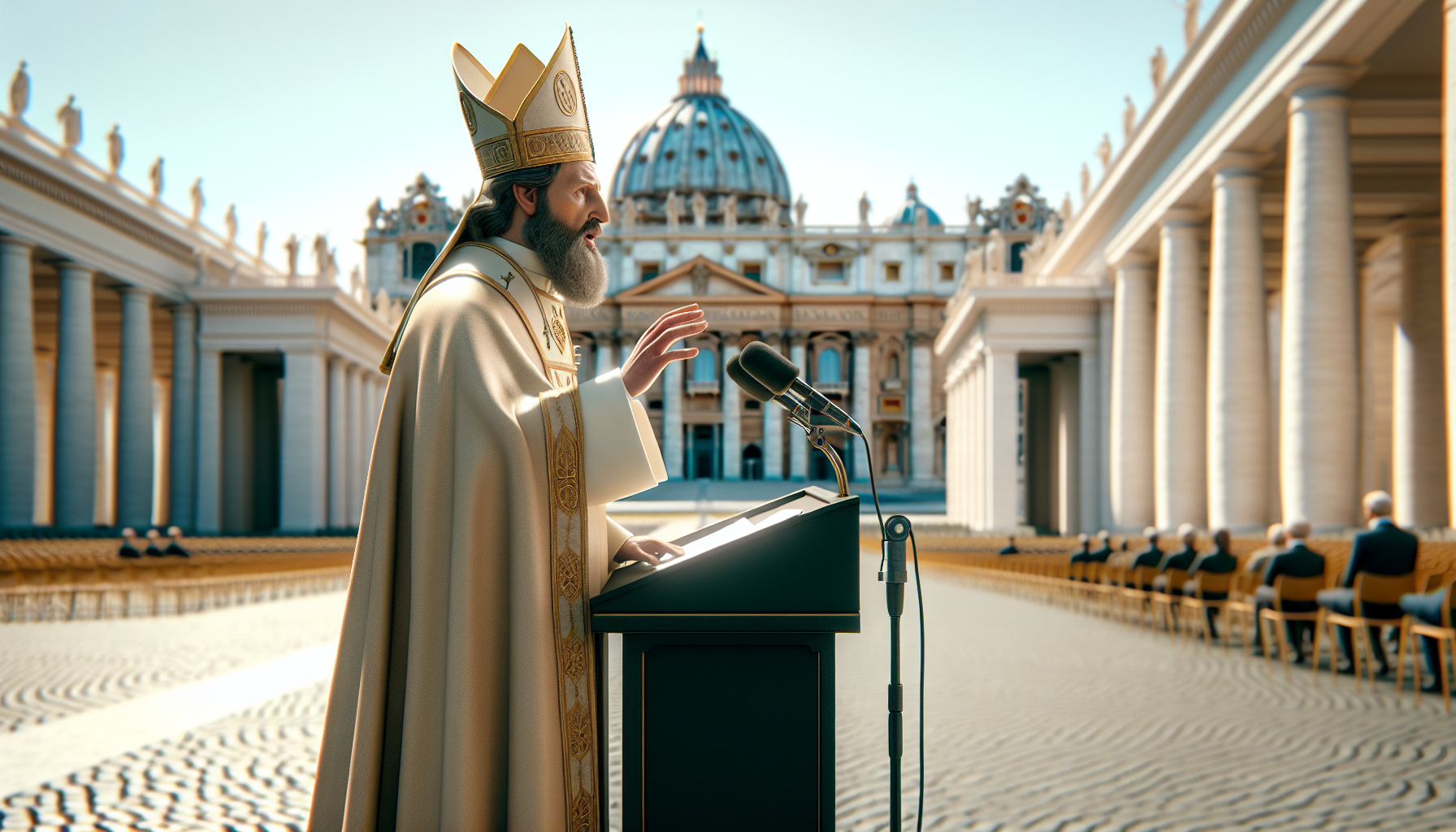
Since his election last May as the first American pope leading the global Catholic Church, Pope Leo initially refrained from commenting on issues related to his home country and did not publicly mention President Donald Trump. However, this period of silence has recently ended. In the past weeks, the pope has become a prominent critic of the ongoing Iran war, explicitly naming Trump for the first time in a public appeal urging the president to seek an end to the escalating conflict.
This notable change in tone and approach signals the pope’s intention to act as a counterbalance to Trump’s foreign policy on the international stage. Massimo Faggioli, an Italian scholar specializing in Vatican affairs, observed that Pope Leo likely aims to avoid any perception that the Vatican is lenient toward Trumpism simply because of his American nationality. Known for his deliberate and measured speech, the pope used the American phrase “off-ramp” to encourage Trump to find a peaceful resolution to the war, a choice of words that would resonate with the president and his administration.
Chicago Cardinal Blase Cupich, a close confidant of Pope Leo, highlighted that the pope is continuing a tradition of pontiffs urging global leaders to reject war. What sets this moment apart, Cupich noted, is that the message is now delivered in a manner familiar to English-speaking audiences, particularly Americans.
In a powerful statement two days before addressing Trump directly, Pope Leo declared that God rejects the prayers of leaders who initiate wars and have “hands full of blood.” These remarks, unusually strong for a Catholic pontiff, were interpreted by conservative Catholic commentators as a critique of U.S. Defense Secretary Pete Hegseth, who has used Christian rhetoric to justify the joint U.S.-Israeli strikes on Iran that sparked the conflict. The pope’s comments prompted one of the Trump administration’s rare direct responses, with White House spokesperson Karoline Leavitt defending the military leaders and the president’s calls for prayers for service members.
Marie Dennis, former head of the international Catholic peace organization Pax Christi, described Pope Leo’s recent statements and his direct appeal to Trump as expressions of a heart deeply troubled by ongoing violence. She emphasized that the pope is reaching out to those weary of relentless conflict and yearning for bold leadership.
For several weeks, Pope Leo has been intensifying his criticism of the Iran war. Earlier, he had questioned whether Trump’s stringent immigration policies aligned with the Church’s pro-life principles, though he avoided naming Trump or his officials directly at that time. In December, the pope also enacted a significant reshuffle in U.S. Catholic leadership by removing Cardinal Timothy Dolan as Archbishop of New York, replacing him with Archbishop Ronald Hicks, a relatively lesser-known cleric from Illinois. Dolan was regarded as a leading conservative voice among U.S. bishops.
On March 13, the pope urged Christian political leaders who initiate wars to reflect through confession on whether their actions conform to Jesus’s teachings. Later, on March 23, he condemned military airstrikes as indiscriminate and called for their prohibition. Cardinal Michael Czerny, a senior Vatican official, affirmed that the pope’s moral authority resonates worldwide because his message advocates for the common good, especially for vulnerable populations. Czerny remarked that Pope Leo’s ethical stance is credible and that the global community desperately hopes for peace.
Beginning Thursday, Pope Leo will preside over four days of Vatican events leading up to Easter Sunday, when he will deliver a special blessing and address from the balcony of St. Peter’s Basilica. This annual occasion is closely watched as a platform for the pope to make significant international appeals.
